
Yoshikazu Fujioka | David Southall | Adam Trahan | Keiichi Okushi | David West Beale
Let's get straight to the point, there is a lot of experience here. We have been fishing long enough to know what works where and have travelled enough to know how our choices served our craft of catching fish. I enjoy this type of article and am honored to be able to coerce the ideas from such a great group of fly fishermen & tenkara fishers.
Yes, the group of us do both.What would your choices be?
How far have you successfully travelled with your choices?
Without going on any longer, let's get into it.
Tenkara flies do not have the distinction between dry flies and wet flies like Western style flies, but this is a dry kebari exclusively for fishing on the water surface.
The hook is #13-#11, tie gold flat tinsel on the hook as the foundation, show the tinsel of about 1-1.5mm on the hook-bend as the tag. The body is made of zenmai fern cotton, silk thread, synthetic dubbing, peacock herl, owl quill, etc., and the hackle is made of rooster, and the tail is not attached. This kebari has the indicator of synthetic wing material to find easily. This is shaped like the cripple pattern of Western fly and may sink half its body to the water surface.
2. Tenkara Soft Hackle Kebari
This is a traditional tenkara kebari pattern, a kebari for underwater fishing and much like the soft hackle pattern of Western flies. The hook is #12-#10, tie the body by zenmai fern cotton that is a traditional material of tenkara kebari, wool yarn, silk thread synthetic dubing, etc. Feathers of pheasant and copper pheasant are often used for the hackle of tenkara kebari, but I like the softness and color of the fiber and also use wing feathers or tail feathers of sparrow.
3. Tenkara Sakasa Kebari
This is sakasa-kebari (reverse hackle fly) that is a pattern of traditional tenkara kebari uses pheasant feathers for the hackle and, this is kebari to fish in the underwater. The hook is #11-#10, tie the body by zenmai fern cotton, wool yarn, silk thread synthetic dubing, etc. Feather of pheasant and copper pheasant are often used for hackles, but I also often use hen hackle and hen saddle. I tie kebari so that it may not become the reverse hackle of narrow angle.
4. CDC Wing Caddis
Various types of caddis can be found in the mountain streams throughout the fishing season. This is a fly that can be adapted to many situations by changing its size and color. This is the fly that I use the most in Western style fly fishing, and it is no exaggeration to say that this is almost the only fly I use throughout the season. The hook is #15-#11, the body by synthetic dubbing and the wing is 2-4 pieces of CDC, the hackle is rooster.
5. Griffith's Gnat
This is a very popular midge size fly that I take as my last resort even when I go tenkara fishing, but I don't use too small size. I use hooks of #18-#12. Not only for fly fishing, but also for tenkara fishing I use it when trout are interested in fly and kebari , but they are wary and do not eat it or when I find a trout that actively rises to midges. I also have a indicator of synthetic wing materia on it for easy to find.
The reason why I chose two kebari/fly
I started Western style fly fishing in the late 1970s. When it comes to fly fishing, the usual approach is to prepare a variety of fly patterns according to the fish's feeding habits, and I was like that at first. However, as I gained more experience, I have come to realize that the fun of fly fishing is not just to fishing, but that there are many more around it.
Today, I think that I only need to catch only the trout that can be caught with my fly, and I enjoy both Tenkara fishing and Fly fishing depending on the conditions of the mountain stream and my mood at that time. I am mainly using the dry kebari also for the tenkara fishing because I liked the dry fly fishing of Western style from the first. To fish the trout on the surface of water has interest different from the fishing by fly of wet type. Although it is not the original tenkara fishing method, tenkara that does not put the line on the water surface does not make an unnatural motion of kebari. It is easy to drift kebari without drag.
In particular, my favorite kebari or fly are my self made dry kebari with a indicator of synthetic wing material to make it easy to find, and the wet type kebari that is used according to the situation such as the early season when trout are not concerned about the water surface.
My self made kebari are tied a gold flat tinsel as the foundation on the hook, and the tinsel of about 1-1.5mm is shown on the hook bend as the tag. It is the mark of my kebari but I don't know the effect of this gold tag well.
I feel that if the kebari is used many times and the material of the body wears down and the tinsel of foundation becomes visible, it will become a hook that can be caught well.
David Southall
I much prefer to fish with dry flies rather than subsurface so only one of my flies is a subsurface pattern. I do occasionally fish with traditional Kebari patterns, but in 2010 when I first saw the Tenkara videos on the Tenkara USA website I realized that it was the perfect way to present my usual dry flies on my annual visits to the boisterous alpine streams of Austria. The tiny pockets of calmer water amongst the maelstrom of white water had caused me and my fishing friend Steve big problems in the past, even when high-sticking with our 10’ 4 weight rods and 14’ leaders.
2010/11 winter was one of our coldest of recent years in the UK and I soon realized the advantages of Tenkara in sub-zero (below 32 degrees F) conditions whilst fishing for grayling. There were no rod rings to freeze up, no wet hands from retrieving fly line and I could keep one hand in my warm pocket whilst wearing a glove on the other hand. Tenkara proved to be perfect for short-line euro-nymphing.
After experimenting with Tenkara for the last thirteen years I now usually only fish with a fixed line on the turbulent, boulder-ridden pocket water where it offers the only means of achieving a good presentation. On these waters the fish tend to be opportunistic and are happy to rise to big flies. I also still sometimes use a Tenkara setup to fish for grayling, particularly in the winter with both subsurface flies and tiny size 24 to 30 CdC Midge.
 |
| Tenkara Dry Kebari #1 |
 |
| Tenkara Dry Kebari #1-2 |
1. Tenkara Dry Kebari
Tenkara flies do not have the distinction between dry flies and wet flies like Western style flies, but this is a dry kebari exclusively for fishing on the water surface.
The hook is #13-#11, tie gold flat tinsel on the hook as the foundation, show the tinsel of about 1-1.5mm on the hook-bend as the tag. The body is made of zenmai fern cotton, silk thread, synthetic dubbing, peacock herl, owl quill, etc., and the hackle is made of rooster, and the tail is not attached. This kebari has the indicator of synthetic wing material to find easily. This is shaped like the cripple pattern of Western fly and may sink half its body to the water surface.
 |
| Tenkara Soft Hackle Kebari #1 |
 |
| Tenkara Soft Hackle Kebari #1-2 |
2. Tenkara Soft Hackle Kebari
This is a traditional tenkara kebari pattern, a kebari for underwater fishing and much like the soft hackle pattern of Western flies. The hook is #12-#10, tie the body by zenmai fern cotton that is a traditional material of tenkara kebari, wool yarn, silk thread synthetic dubing, etc. Feathers of pheasant and copper pheasant are often used for the hackle of tenkara kebari, but I like the softness and color of the fiber and also use wing feathers or tail feathers of sparrow.
 |
| Tenkara Sakasa Kebari |
3. Tenkara Sakasa Kebari
This is sakasa-kebari (reverse hackle fly) that is a pattern of traditional tenkara kebari uses pheasant feathers for the hackle and, this is kebari to fish in the underwater. The hook is #11-#10, tie the body by zenmai fern cotton, wool yarn, silk thread synthetic dubing, etc. Feather of pheasant and copper pheasant are often used for hackles, but I also often use hen hackle and hen saddle. I tie kebari so that it may not become the reverse hackle of narrow angle.
 |
| CDC Wing Caddis |
4. CDC Wing Caddis
Various types of caddis can be found in the mountain streams throughout the fishing season. This is a fly that can be adapted to many situations by changing its size and color. This is the fly that I use the most in Western style fly fishing, and it is no exaggeration to say that this is almost the only fly I use throughout the season. The hook is #15-#11, the body by synthetic dubbing and the wing is 2-4 pieces of CDC, the hackle is rooster.
 |
| Griffith's Gnat |
5. Griffith's Gnat
This is a very popular midge size fly that I take as my last resort even when I go tenkara fishing, but I don't use too small size. I use hooks of #18-#12. Not only for fly fishing, but also for tenkara fishing I use it when trout are interested in fly and kebari , but they are wary and do not eat it or when I find a trout that actively rises to midges. I also have a indicator of synthetic wing materia on it for easy to find.
The reason why I chose two kebari/fly
I started Western style fly fishing in the late 1970s. When it comes to fly fishing, the usual approach is to prepare a variety of fly patterns according to the fish's feeding habits, and I was like that at first. However, as I gained more experience, I have come to realize that the fun of fly fishing is not just to fishing, but that there are many more around it.
Today, I think that I only need to catch only the trout that can be caught with my fly, and I enjoy both Tenkara fishing and Fly fishing depending on the conditions of the mountain stream and my mood at that time. I am mainly using the dry kebari also for the tenkara fishing because I liked the dry fly fishing of Western style from the first. To fish the trout on the surface of water has interest different from the fishing by fly of wet type. Although it is not the original tenkara fishing method, tenkara that does not put the line on the water surface does not make an unnatural motion of kebari. It is easy to drift kebari without drag.
In particular, my favorite kebari or fly are my self made dry kebari with a indicator of synthetic wing material to make it easy to find, and the wet type kebari that is used according to the situation such as the early season when trout are not concerned about the water surface.
My self made kebari are tied a gold flat tinsel as the foundation on the hook, and the tinsel of about 1-1.5mm is shown on the hook bend as the tag. It is the mark of my kebari but I don't know the effect of this gold tag well.
I feel that if the kebari is used many times and the material of the body wears down and the tinsel of foundation becomes visible, it will become a hook that can be caught well.
--------------------
David Southall
I much prefer to fish with dry flies rather than subsurface so only one of my flies is a subsurface pattern. I do occasionally fish with traditional Kebari patterns, but in 2010 when I first saw the Tenkara videos on the Tenkara USA website I realized that it was the perfect way to present my usual dry flies on my annual visits to the boisterous alpine streams of Austria. The tiny pockets of calmer water amongst the maelstrom of white water had caused me and my fishing friend Steve big problems in the past, even when high-sticking with our 10’ 4 weight rods and 14’ leaders.
2010/11 winter was one of our coldest of recent years in the UK and I soon realized the advantages of Tenkara in sub-zero (below 32 degrees F) conditions whilst fishing for grayling. There were no rod rings to freeze up, no wet hands from retrieving fly line and I could keep one hand in my warm pocket whilst wearing a glove on the other hand. Tenkara proved to be perfect for short-line euro-nymphing.
After experimenting with Tenkara for the last thirteen years I now usually only fish with a fixed line on the turbulent, boulder-ridden pocket water where it offers the only means of achieving a good presentation. On these waters the fish tend to be opportunistic and are happy to rise to big flies. I also still sometimes use a Tenkara setup to fish for grayling, particularly in the winter with both subsurface flies and tiny size 24 to 30 CdC Midge.
So here are my 5 favorite flies for Tenkara.
This has proved to be a deadly pattern throughout the summer on all of the waters that I fish. Its name dates back to a fishing session in the in the Austrian alps near Gerlos when I followed a French angler up a pool on the Schonachbach. He failed to catch anything, whilst I landed 3 good sized rainbow trout with my black beetle imitation. On my return to the hotel later in the day the French guy was telling his mates about this English man who was catching loads of fish with a “Scarab Noire”. A couple of years later friends Stuart Crofts and Don Stazicker (both top UK fly fishers) joined Steve Donohue and I on a trip to the same hotel. On our arrival who should be there but the French man who enthusiastically greeted me as “Monsieur le Scarab Noire”. On that trip I was given the challenge to catch the first fish each day on my Scarab Noire. It was September and one morning we woke up to find a heavy snowfall and a temperature of -6 degrees C at the alpine hut on the Krimmler Ache, altitude 5200 feet. Trudging through the falling snow I seriously doubted my ability to rise a fish to the foam beetle, but I need not have worried; casting my fly into a small pool on a side stream we saw several bow waves head for my offering. The result was a little brook trout securely hooked. For the rest of the day I continued to catch both brook trout and brown trout from the main river using the same fly. Cast it with a plop into a pocket in the white water of an alpine stream and give it a subtle twitch or two (something that is impossible with a conventional rod and fly line) and if there is fish there a take is virtually guaranteed.
Hook: Size 12 or 10 dry fly
Thread: Black
Body: Peacock Ice Dub or peacock herl
Back: 2mm black sealed cell foam
Legs: 2 strands of single-knotted peacock here, untied in on each side
Sighter: Pink poly yarn
Apply super glue where the foam is tied in to prevent it from rotating on the hook shank.
2. Size 14 to 10 Elk Hair Caddis
The late Malcolm Greenhalgh, one of the UK’s top fly fishers, once described the Elk Hair Caddis as one of the world’s most successful dry flies. It imitates not only adult caddis/sedge flies, but also stoneflies, alder flies and moths. If I ever had to fish with only one dry fly then this would be the one. It is a fly that will lift up fish that are not actively searching for surface food. Furthermore, it floats well and its weight and streamlined shape helps it to punch into the wind. Furthermore, it is highly visible against dark backgrounds such as at dusk. When fished against light backgrounds I often add a sighter of pink poly yarn. I’ve caught brown trout, rainbow trout, various species of char and grayling all over the world using this pattern. If the fish are reticent about taking it dead-drift I either give it a few twitches or drag it so that it creates a bow-wave to induce a take.
Hook: Size 14 to 10 dry fly
Thread Tan or brown
Tag (optional): Brown poly yarn (this helps with buoyancy)
Body: Spiky squirrel dubbing
Under-wing: Brown deer hair
Over-wing: Bleached Elk
3. Size 14 or 12 Long-shank Chernobyl Ant
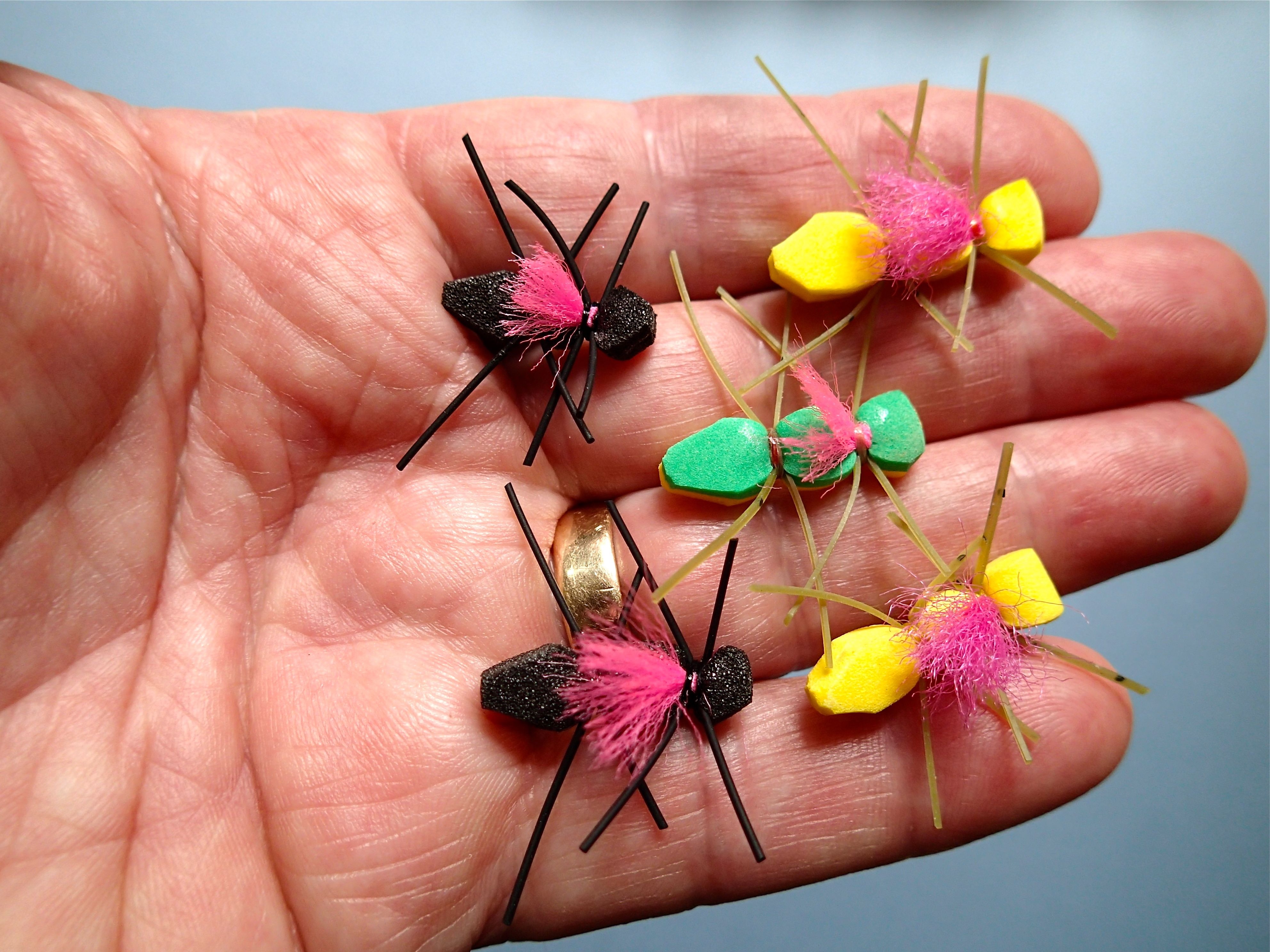
This is a deadly fly on the high alpine streams of Austria and Italy and I am sure elsewhere. It is a good imitation of grasshoppers, crickets and large beetles. It is very buoyant so floats well on turbulent water and does not need repeated applications of flotant. Its weight makes it easy to cast into the wind and the plop that it makes when landing lets the fish, even in the most turbulent stream, know that potential food had landed on the water. Furthermore, being bulky, with a large surface area in contact with the water, it ‘anchors’ to the surface so is not dragged out of small pockets by any line-sag (I always fish with the lightest level fluorocarbon line that is possible). Brook trout in particular love a twitched Chernobyl Ant, simulating the struggling of a large insect trapped in the surface film and even small ones will engulf this big fly.
Hook: Size 12 long-shank
Thread: Any colour 6/0 (this thickness so that it doesn’t cut into the foam)
Body: 2 layers of 2mm sealed cell foam. Any color (green, yellow or brown if there are lots of grasshoppers about, but I usually use black)
Legs: Black brown or green rubber-legs
Sighter: Pink poly yarn
4. Size 10 (Black) Klinkhamer
Hans van Klinken’s Klinkhamer was originally designed as an imitation of the large emerging caddis flies/sedges that are common in Sweden and Norway. It has now morphed into patterns that imitate a number of emerging or half-drowned insects. This is another fly that, thanks to its submerged rear end, ‘anchors’ well into the river surface resisting any drag from currents or line-sag. It is a suitable representation of a range to terrestrial insect and tied with a brown body and hackle is a good imitation of the larger Heptageneids and emerging caddis/sedge flies.
Hook: Size 10 grub or Klinkhamer
Thread: Black or brown
Body: Black or brown ice dub or similar
Hackle: Black, brown or grizzle genetic cock
Post/wing: Pink, grey, white or brown poly yarn
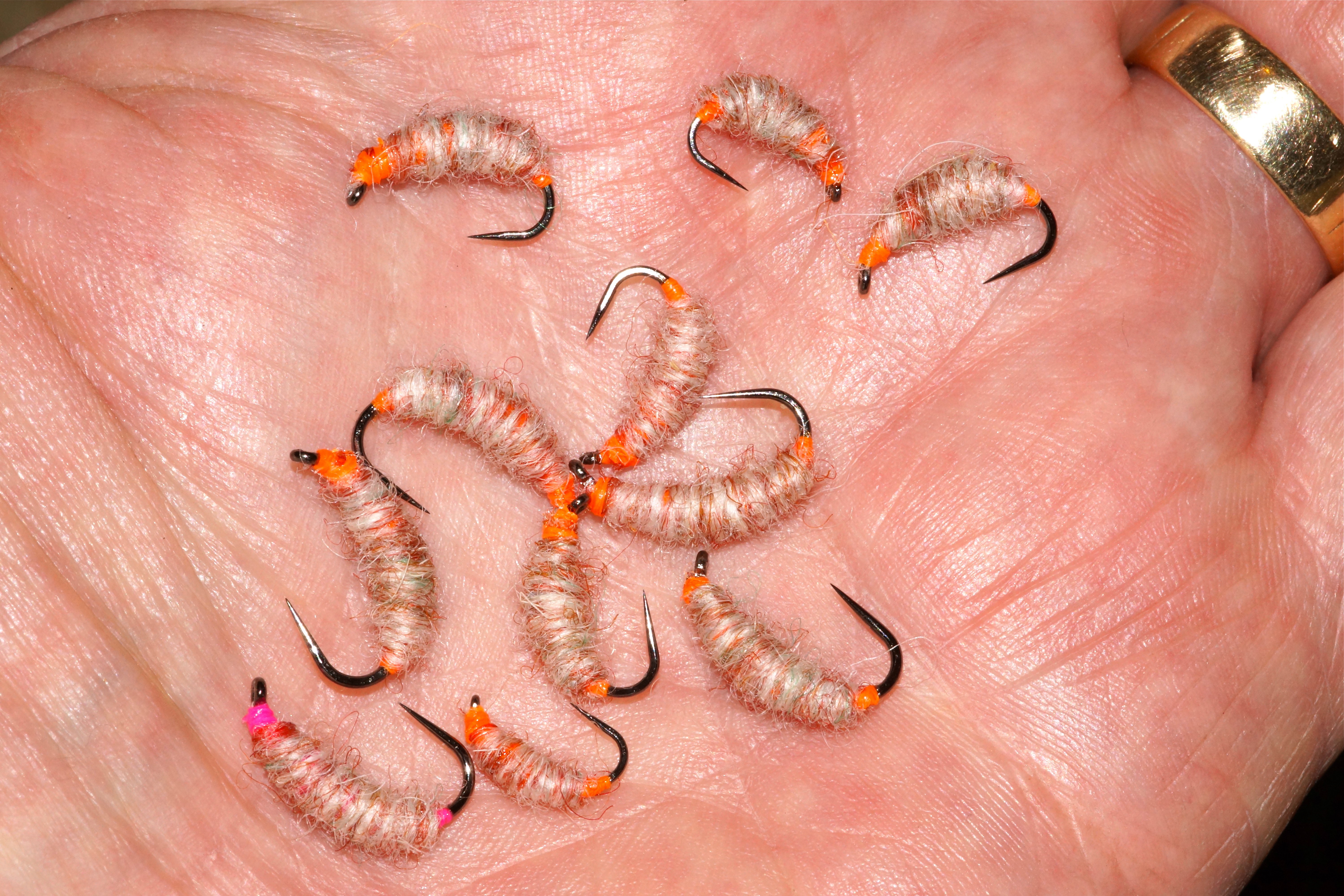
5. Orange Utah Killer Bug variant
I would not be without this sub-surface fly, particularly when fishing for grayling. The original Frank Sawyer’s Killer Bug was designed to kill grayling on his part of the Hampshire Avon where there were so many grayling that they were at that time considered to be vermin. It was tied with just reddish colored copper wire taken from a transformer and Chadwick’s 477 wool, a greyish brown with a hint of pink. The wire under-body gave it some weight so that it would sink to the depth at which the grayling normally feed, close to the river bed. It subsequently proved to be effective for trout as well as the grayling.
Hook: Size 16 to 10 grub
Thread: Orange or pink Globrite Floss
Under-body: 1 layer of lead wire or lead substitute covered with the floss
Over-body: 1 layer of Jamieson’s Shetland Spindrift wool

There is no one single pattern that I stick to. It could be a variety of feather types on a keiryu hook with zenmai or the fiddle head fern fuzz applied to the hook as a body. I have heard more than once from Japanese tenkara fishers that zenmai can easily be replaced by any number of dubbing choices.


Bead Head Mini Leach

Keiichi Okushi
Osawa Kebari
One of my genryu fishing friend Osawa-san (Mr. Kenji Osawa) recently became a tenkara fishing field tester for Shimano. So, I would like to introduce 3 of my favorite kebari that Osawa-san ties.
Before talking about his kebari, I would like to introduce Osawa-san a little. Osawa-san was Born in Fujimi City, Saitama Prefecture in 1972.
He began Fishing at the age of 7 with freshwater fish such as crucian carp and motsugo. He started mountain stream bait fishing at the age of 20, and moved to tenkara in his late 20s when he started going to genryu. He was working for a major fishing tackle store for over 20 years. Therefore, he has deep knowledges and experiences in various types of fishing. He is currently active as a Shimano tenkara fishing field tester, and he also acts as the ambassador for tenkara brand "10colors", and a fishing writer.
Zenmai-dou Akashiba Hanagasa
We use this kebari all season long. Especially from March to May, when there are many mayflies such as Kinpaku and Pinchoro hatch, this pattern does great job. Body material is zenmai cotton, that has been used for body material since long time ago in Japan. Akashiba is the name of a Japanese dog, and he named it so because it has a similar hair color to this kebari. Hen feathers are used for brown and brown speckled. Peacock is used for the chest, and it is put in to give it a little appeal. The copper wire on the body is not only realistic, but also has the meaning of improving the durability of the zenmai body, which is easy to unravel.
Zenmai-dou Akashiba Sakasa
It is a Hanagasa sakasa pattern kebari. You can drift it without action, but if you give a detailed action, the sakasa hackle moves like open and close, increasing the sense of life. Hen's feathers are used for the hackle to give it the softness.
Kai-dou Kurotora Hanagasa
We use all season. I use it when black river bugs and aquatic insects hatch even in early spring. Even after early summer, when there are many black terrestrial insects, it is a good kebari with a stable response. We use soft hen feathers. The peacock on the chest is put in to increase the appeal a little.
Other 2 kebari I mainly use are as follows.
Adams Parachute
As I am also the western fly fisher and I like dry fly fishing, I often use western dry flies such as parachute patterns or elk hair caddis patterns. My most favorite dry fly is Adams Parachute or March Brown Parachute. I love dry fly fishing because I can see the fish bites on the surface of water. It is exciting and I often tie these parachute flies on my tenkara line.
Sebata Kebari Kijibane Sakasa kuro
I always keep this kebari in my kebari case as a way of showing my greatest respect to Sebata-san, who had led the headwater fishing world for a long time.
Kiji-bane Sakasa Kuro is the most famous Sebata Kebari patern. The body was tied with self sticking tape, which is Yuzo Sebata's favorite material. The tape has certain weight and kebari sinks well. Soft pheasant feathers shimmer well in the water and entices trout. So to give action to the kebari is ideal for this patern.

Our fly boxes can tell a lot about the kind of fishing we enjoy - preferred species, types of water, styles of presentation, philosophy even.
Here is my journey to five kebari I would take anywhere…
Several seasons ago, I took a limited box of flies with me to the water but found that I was defaulting to one pattern more and more. At first it wasn't a conscious decision, it just seemed that this particular pattern caught more fish more often, and of course once a fly becomes a favorite it is in effect a self-fulfilling prophesy. Because, of all your flies, this one spends the most time in the water, it stands to reason that it will probably catch you the most fish… until of course it doesn't and then you experiment with a different fly, perhaps get some instant success and then a new favorite emerges…
This fly choice is very subjective and most probably matched not so much to any hatch, but more to the random good fortune of catching a fish that has been offered up by the alignment of all sorts of unknown variables. But as time goes on we rationalize our fly choice, even develop our own theories or adopt the theories of others about why this or that fly works. However, if we were to try to prove our theory in any scientific way we would only have very scant data on which to base our observations, probably no control subject and absolutely no controlled environment. So we must say that our faith in a particular fly is exactly that - an act of faith or at best, flimsy empirical observation. Rather than faith, I prefer to think of it as ‘confidence’ and as we all know, confidence in fishing is a very large part of success.

And herein lies the dilemma of the abundant fly box, for when our go-to pattern/s fail us we search for a new fly that will work. We try this pattern, we try that pattern, but the more choice we have the more likely we are to confuse ourselves with options. And confusion leads to a lowering of confidence. Not only are we no longer fishing effectively but we are actually fishing less - because with all the chopping and changing of flies we have a fly in the water for less of the time. Perhaps then we look to others for advice, which is fine, but wouldn't we really be happier avoiding these pitfalls in the first place?
In contrast to a western-style imitative fly, the kebari is a blank canvas on which to paint a representation of life. This is achieved through how we cast and where, when and how we fish our fly. Our kebari is tied to give an impression of nothing in particular except that of life. The skill is in presenting our kebari to the fish in such a way that it is induced to take our fly, regardless of the natural food forms present.
When I decided that for some of my fishing trips I would limit myself to just one pattern, it was with the intention of developing my fishing skills. I would explore the many ways a single fly pattern can be fished and manipulated with tenkara.
So now, instead of trying to match a fly to any particular scenario I'm selecting a method of presentation to tackle that scenario. For most of my fishing last season I used just one pattern of kebari in size a 14 for some trips and the same pattern in a size 16 (but with a tiny bead head) for other trips. Never did I switch between the two versions during the day, I stuck instead with my initial choice for each particular trip. I should also explain here that I often use a tenkara approach to catch many species other than trout and it was with these in mind that the size 16 bead head kebari was used. If I was fishing only for trout I could have literally confined myself to just one pattern for all of my trips and still have fished with confidence. I would also say that the precise pattern is not so important - I would be equally happy to follow the same approach this season with a different 'one fly'.

These are the benefits I discovered from a one fly approach which are of course highly subjective but worth sharing:
• no worries
With one fly I am relaxed and free from worry about things I cannot change:
I'm freed from the worry of leaving this or that pattern at home by mistake or losing my last one of that type in a tree or on a rock - it's pretty quick and easy to tie up a half a dozen kebari of the same pattern at home - more than enough for me for a trip and as long as I take them with me there's not much else to worry about..
I'm freed from the worry that I am fishing with the 'wrong' fly pattern - since I only have one pattern I must by definition be fishing with the right one..
• simplicity
With one fly comes simplicity and with simplicity comes clarity, efficiency and elegance:
With my one fly tied on I can arrive at the water and be fishing within seconds if I wish. If on the other hand I wish to just sit and observe, I am ready to fish instantly when the desire arises, with no fumbling around for the 'correct' pattern..
and since I'm not chopping and changing patterns, I'm spending more time actually fishing my fly in the water, or alternatively I have more time to stop and observe..
• travelling light
one simple little fly box..
• clarity
freedom from the confusion of too many choices of fly pattern and freedom to think just about reading the water and observing the fish's behaviour..
• learning
on-stream, because I'm free to focus on learning to read the water and observe fish behaviour, I'm more open to learning which approach might provide an effective presentation - and since I'm always using the same fly it's a swifter route to learning the subtle nuances of each presentation and how they may be influenced by us or the environment..
• authenticity
because there is nowhere to hide with the one fly approach, success is more rewarding and more authentic - somehow I feel more of an angler in the purest sense, fishing this way..
Where to next?
By fishing one fly and enjoying these benefits I created a space for myself where I could relax and enjoy my fishing more, catch more fish and learn new approaches. Because of extensive fishing of this one pattern I also learned the limitations of the dark colored soft hackle sakasa kebari I chose to restrict myself to.
Given differing light conditions and colors of river bed gravels, I felt there were times when a light colored fly would be easier for me to see and/or the fish to see. There were also times when I would have liked a stiff hackle version to try surface manipulations more effectively or to hold my fly in a pocket within the flow.

And while none of this is really a surprise it does guide me very nicely in my fly box choices for this year. A collection of just five patterns - a dark soft hackle and a light soft hackle kebari, together with a dark colored and a light-colored stiff hackle kebari, plus a bead head soft hackle. A small collection of flies that will allow me to overcome these 'restrictions' and provide a large repertoire of presentations. More than almost anywhere else in fly fishing, the design of kebari are defined by their intended function, how they will be presented, how they will be fished.
None of these considerations are entomology-based, but they are nevertheless very effective routes to catching fish by induced take. In fact I have my suspicions that even with western style flies most takes are in reality induced and seldom do we actually deceive a fish into mistaking our fly for a specific insect. But this is another subject entirely and one for another time…
.jpg)
 |
| Flip Flop Scarab Noire side view |
1. Size 12 or 10 Flip Flop Scarab Noire
This has proved to be a deadly pattern throughout the summer on all of the waters that I fish. Its name dates back to a fishing session in the in the Austrian alps near Gerlos when I followed a French angler up a pool on the Schonachbach. He failed to catch anything, whilst I landed 3 good sized rainbow trout with my black beetle imitation. On my return to the hotel later in the day the French guy was telling his mates about this English man who was catching loads of fish with a “Scarab Noire”. A couple of years later friends Stuart Crofts and Don Stazicker (both top UK fly fishers) joined Steve Donohue and I on a trip to the same hotel. On our arrival who should be there but the French man who enthusiastically greeted me as “Monsieur le Scarab Noire”. On that trip I was given the challenge to catch the first fish each day on my Scarab Noire. It was September and one morning we woke up to find a heavy snowfall and a temperature of -6 degrees C at the alpine hut on the Krimmler Ache, altitude 5200 feet. Trudging through the falling snow I seriously doubted my ability to rise a fish to the foam beetle, but I need not have worried; casting my fly into a small pool on a side stream we saw several bow waves head for my offering. The result was a little brook trout securely hooked. For the rest of the day I continued to catch both brook trout and brown trout from the main river using the same fly. Cast it with a plop into a pocket in the white water of an alpine stream and give it a subtle twitch or two (something that is impossible with a conventional rod and fly line) and if there is fish there a take is virtually guaranteed.
 |
| Flip Flop Scarab Noire bottom view |
Tying:
Hook: Size 12 or 10 dry fly
Thread: Black
Body: Peacock Ice Dub or peacock herl
Back: 2mm black sealed cell foam
Legs: 2 strands of single-knotted peacock here, untied in on each side
Sighter: Pink poly yarn
Apply super glue where the foam is tied in to prevent it from rotating on the hook shank.
 |
| Elk Hair Caddis |
2. Size 14 to 10 Elk Hair Caddis
The late Malcolm Greenhalgh, one of the UK’s top fly fishers, once described the Elk Hair Caddis as one of the world’s most successful dry flies. It imitates not only adult caddis/sedge flies, but also stoneflies, alder flies and moths. If I ever had to fish with only one dry fly then this would be the one. It is a fly that will lift up fish that are not actively searching for surface food. Furthermore, it floats well and its weight and streamlined shape helps it to punch into the wind. Furthermore, it is highly visible against dark backgrounds such as at dusk. When fished against light backgrounds I often add a sighter of pink poly yarn. I’ve caught brown trout, rainbow trout, various species of char and grayling all over the world using this pattern. If the fish are reticent about taking it dead-drift I either give it a few twitches or drag it so that it creates a bow-wave to induce a take.
Hook: Size 14 to 10 dry fly
Thread Tan or brown
Tag (optional): Brown poly yarn (this helps with buoyancy)
Body: Spiky squirrel dubbing
Under-wing: Brown deer hair
Over-wing: Bleached Elk
 |
| Long-shank Chernobyl Ant |
3. Size 14 or 12 Long-shank Chernobyl Ant
This is a deadly fly on the high alpine streams of Austria and Italy and I am sure elsewhere. It is a good imitation of grasshoppers, crickets and large beetles. It is very buoyant so floats well on turbulent water and does not need repeated applications of flotant. Its weight makes it easy to cast into the wind and the plop that it makes when landing lets the fish, even in the most turbulent stream, know that potential food had landed on the water. Furthermore, being bulky, with a large surface area in contact with the water, it ‘anchors’ to the surface so is not dragged out of small pockets by any line-sag (I always fish with the lightest level fluorocarbon line that is possible). Brook trout in particular love a twitched Chernobyl Ant, simulating the struggling of a large insect trapped in the surface film and even small ones will engulf this big fly.
Hook: Size 12 long-shank
Thread: Any colour 6/0 (this thickness so that it doesn’t cut into the foam)
Body: 2 layers of 2mm sealed cell foam. Any color (green, yellow or brown if there are lots of grasshoppers about, but I usually use black)
Legs: Black brown or green rubber-legs
Sighter: Pink poly yarn
 |
| (Black) Klinkhamer |
4. Size 10 (Black) Klinkhamer
Hans van Klinken’s Klinkhamer was originally designed as an imitation of the large emerging caddis flies/sedges that are common in Sweden and Norway. It has now morphed into patterns that imitate a number of emerging or half-drowned insects. This is another fly that, thanks to its submerged rear end, ‘anchors’ well into the river surface resisting any drag from currents or line-sag. It is a suitable representation of a range to terrestrial insect and tied with a brown body and hackle is a good imitation of the larger Heptageneids and emerging caddis/sedge flies.
Hook: Size 10 grub or Klinkhamer
Thread: Black or brown
Body: Black or brown ice dub or similar
Hackle: Black, brown or grizzle genetic cock
Post/wing: Pink, grey, white or brown poly yarn
 |
| Orange Utah Killer Bug variant |
5. Orange Utah Killer Bug variant
I would not be without this sub-surface fly, particularly when fishing for grayling. The original Frank Sawyer’s Killer Bug was designed to kill grayling on his part of the Hampshire Avon where there were so many grayling that they were at that time considered to be vermin. It was tied with just reddish colored copper wire taken from a transformer and Chadwick’s 477 wool, a greyish brown with a hint of pink. The wire under-body gave it some weight so that it would sink to the depth at which the grayling normally feed, close to the river bed. It subsequently proved to be effective for trout as well as the grayling.
When I first saw the Utah Killer Bug, a variant of Sawyer’s pattern, in a post on the internet that I believe was by the Utah Tenkara Guides, I thought that it looked interesting. Their pattern substituted pink wire for Sawyers reddish wire and Jamieson’s Shetland Spindrift, oyster coloured wool for the Chadwicks’ wool. However, the pink wire base was far too light to take a fly down to the grayling in the deep sections of my local chalk stream, Driffield Beck. As a result, I tied some up with a lead wire base covered with fluorescent pink Globrite Floss, before covering with a single layer of the oyster colored wool. A single layer of wool over the bright floss ensures that the colour pink to ‘glow’ through the wool when the fly is wet. This and a small bit of pink thread exposed at the hook bend and where the fly is tied off I am sure act as attractants.
I have found the pink version to be very effective for both grayling and trout, but knowing that grayling have a taste for orange as indicated by their preference for scuds/Gammarus that are infected with the acanthocephalan parasite, Pomphorhynchus laevis, that accumulates the carotenoid pigments in the scud’s body producing a bright orange spot in the middle of the scud’s body, I therefore tied some up with fluorescent orange Globrite floss and it is this version that has accounted for many UK grayling up to over 3 pounds.
My best Tenkara session on my local chalk stream resulted in nine big grayling being hooked with seven from 1 pound 10 ounces to 2 pounds 15 ounces being landed in just twenty minutes from one deep pool.
 |
| Pink Utah Killer Bug variant |
Hook: Size 16 to 10 grub
Thread: Orange or pink Globrite Floss
Under-body: 1 layer of lead wire or lead substitute covered with the floss
Over-body: 1 layer of Jamieson’s Shetland Spindrift wool
--------------------
26 years ago, I meet Yoshikazu Fujioka, we had just started making our fly-fishing web sites. We corresponded and began a friendship through fly fishing and now tenkara.
His web site can be found at this link: My Best Streams
The first version of the idea of a few favorite flys are detailed here: Fly Box
Fujioka san is the resource for tenkara kebari. Although I use only a few versions of tenkara kebari, if I were to experiment more, his site is where I would do my research. What I have found is that tenkara kebari are related to "communities in different areas" and different materials sourced from the area of the community. Historically, kebari patterns were not shared as they were the tenkara secrets of the profession bringing trout to market.
Now that tenkara is a sport fishing choice, and with the advent of the Internet, tenkara kebari patterns are shared from common resources such as magazines and books as well as online.
My fly fishing fly choices has evolved since I have been fishing tenkara for the last fourteen years. I tend to use flys that work everywhere. The Caddis Dry is almost an attracter pattern. The Zebra midge imitates a variety of midges and the Pine Squirrel Leech is a streamer that imitates all kinds of aquatic life. The Zenmai kebari is my choice of respect to the old ways of tenkara. But it is often that magic fly that wards off the evil spirit that is a skunk.
In short, my five fly/kebari have now been influenced by my love of both tenkara and fly fishing and
are detailed below.
In no particular order.
- Wrong Kebari
- Zenmai Kebari
- Caddis Dry
- Zebra Midge
- Bead Head Pine Squirrel Leech
Wrong Kebari

This fly/kebari epitomizes my tenkara choice. The hook is made for nesting type rods, the soft hackle provides "action" and the addition of a small tungsten bead will promote hook point up weedless presentation and enhanced water column availability as well as a uniform swimming pattern. I started out with the pattern as a un-weighted fly but now prefer the beaded version.
The recipe and story for the Wrong Kebari can be found at this link: Wrong Kebari
...and the development of the beaded version can be found at this link: Wrong Kebari with bead.
 |
| Wrong Fly with tungsten bead variation (bead is buried at the start of the hook bend) |
Zenmai Kebari
 |
| The last zenmai kebari I tyed |
I disagree.
For me, it isn't replaceable.
It IS tenkara and represents where tenkara is from and I am taking zenmai with me.
Caddis Dry
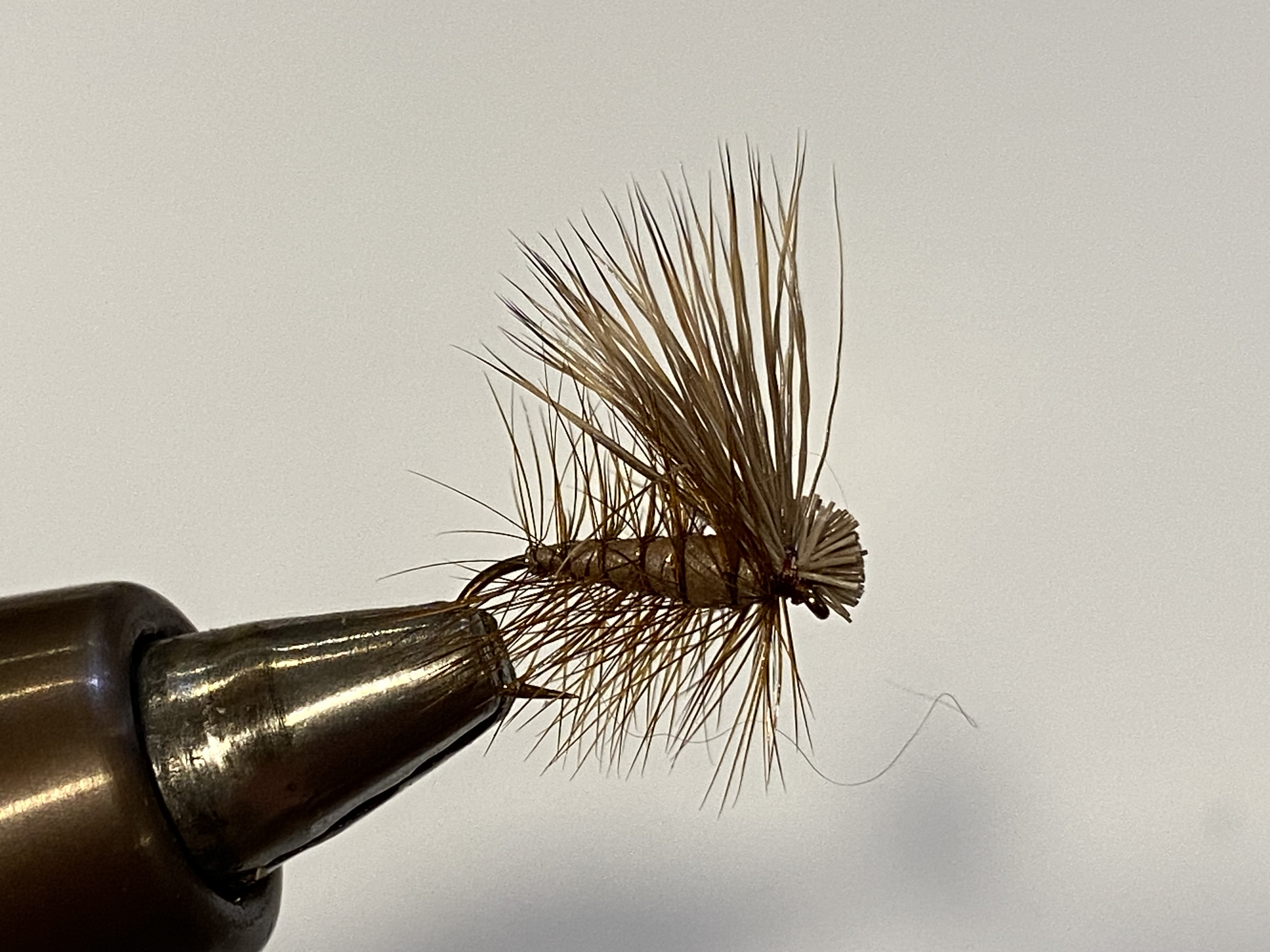 |
| I tied this one 25+ years ago |
My first dry fly that I caught a fish or at least the first fly that I caught fish on that I knew the pattern name. My first dry fly that I have tied (and caught a fish on) and it is a pattern that I have used not matching the hatch and still caught at a good catch rate.
Easy to see, very useful and productive fly.
Zebra Midge

Ted Welling, inventor of the Zebra Midge recently passed. He worked with Lees Ferry Anglers on the Colorado River. I've been fishing the Zebra Midge for big tailwater trout since day one of my fly fishing and it works equally as well with honryu tenkara. Although I do not choose a Zebra Midge for keiryu tenkara, it would work and probably work very well as it imitates a variety of insects in their larval form. The Zebra Midge is a big fish fly I would not be caught without, tenkara or fly.

Bead Head Mini Leach

...or a bead head wooly bugger but I am picking this streamer version more and more and it is a fly that works in all types of streams and rivers for BIG FISH.
I have even used this for #untenkara in urban impoundments.
Easy to tye, I use a tungsten bead.
--------------------
 |
| Mr. Kenji Osawa |
Osawa Kebari
One of my genryu fishing friend Osawa-san (Mr. Kenji Osawa) recently became a tenkara fishing field tester for Shimano. So, I would like to introduce 3 of my favorite kebari that Osawa-san ties.
Before talking about his kebari, I would like to introduce Osawa-san a little. Osawa-san was Born in Fujimi City, Saitama Prefecture in 1972.
He began Fishing at the age of 7 with freshwater fish such as crucian carp and motsugo. He started mountain stream bait fishing at the age of 20, and moved to tenkara in his late 20s when he started going to genryu. He was working for a major fishing tackle store for over 20 years. Therefore, he has deep knowledges and experiences in various types of fishing. He is currently active as a Shimano tenkara fishing field tester, and he also acts as the ambassador for tenkara brand "10colors", and a fishing writer.
 |
| Zenmai-dou Akashiba Hanagasa |
Zenmai-dou Akashiba Hanagasa
We use this kebari all season long. Especially from March to May, when there are many mayflies such as Kinpaku and Pinchoro hatch, this pattern does great job. Body material is zenmai cotton, that has been used for body material since long time ago in Japan. Akashiba is the name of a Japanese dog, and he named it so because it has a similar hair color to this kebari. Hen feathers are used for brown and brown speckled. Peacock is used for the chest, and it is put in to give it a little appeal. The copper wire on the body is not only realistic, but also has the meaning of improving the durability of the zenmai body, which is easy to unravel.
 |
| Zenmai-dou Akashiba Sakasa |
Zenmai-dou Akashiba Sakasa
It is a Hanagasa sakasa pattern kebari. You can drift it without action, but if you give a detailed action, the sakasa hackle moves like open and close, increasing the sense of life. Hen's feathers are used for the hackle to give it the softness.
 |
| Kai-dou Kurotora Hanagasa |
Kai-dou Kurotora Hanagasa
We use all season. I use it when black river bugs and aquatic insects hatch even in early spring. Even after early summer, when there are many black terrestrial insects, it is a good kebari with a stable response. We use soft hen feathers. The peacock on the chest is put in to increase the appeal a little.
Other 2 kebari I mainly use are as follows.
 |
| Adams Parachute |
Adams Parachute
As I am also the western fly fisher and I like dry fly fishing, I often use western dry flies such as parachute patterns or elk hair caddis patterns. My most favorite dry fly is Adams Parachute or March Brown Parachute. I love dry fly fishing because I can see the fish bites on the surface of water. It is exciting and I often tie these parachute flies on my tenkara line.
 |
| Sebata Kebari Kijibane Sakasa kuro |
Sebata Kebari Kijibane Sakasa kuro
I always keep this kebari in my kebari case as a way of showing my greatest respect to Sebata-san, who had led the headwater fishing world for a long time.
Kiji-bane Sakasa Kuro is the most famous Sebata Kebari patern. The body was tied with self sticking tape, which is Yuzo Sebata's favorite material. The tape has certain weight and kebari sinks well. Soft pheasant feathers shimmer well in the water and entices trout. So to give action to the kebari is ideal for this patern.
--------------------

Our fly boxes can tell a lot about the kind of fishing we enjoy - preferred species, types of water, styles of presentation, philosophy even.
Here is my journey to five kebari I would take anywhere…
Several seasons ago, I took a limited box of flies with me to the water but found that I was defaulting to one pattern more and more. At first it wasn't a conscious decision, it just seemed that this particular pattern caught more fish more often, and of course once a fly becomes a favorite it is in effect a self-fulfilling prophesy. Because, of all your flies, this one spends the most time in the water, it stands to reason that it will probably catch you the most fish… until of course it doesn't and then you experiment with a different fly, perhaps get some instant success and then a new favorite emerges…
This fly choice is very subjective and most probably matched not so much to any hatch, but more to the random good fortune of catching a fish that has been offered up by the alignment of all sorts of unknown variables. But as time goes on we rationalize our fly choice, even develop our own theories or adopt the theories of others about why this or that fly works. However, if we were to try to prove our theory in any scientific way we would only have very scant data on which to base our observations, probably no control subject and absolutely no controlled environment. So we must say that our faith in a particular fly is exactly that - an act of faith or at best, flimsy empirical observation. Rather than faith, I prefer to think of it as ‘confidence’ and as we all know, confidence in fishing is a very large part of success.

And herein lies the dilemma of the abundant fly box, for when our go-to pattern/s fail us we search for a new fly that will work. We try this pattern, we try that pattern, but the more choice we have the more likely we are to confuse ourselves with options. And confusion leads to a lowering of confidence. Not only are we no longer fishing effectively but we are actually fishing less - because with all the chopping and changing of flies we have a fly in the water for less of the time. Perhaps then we look to others for advice, which is fine, but wouldn't we really be happier avoiding these pitfalls in the first place?
In contrast to a western-style imitative fly, the kebari is a blank canvas on which to paint a representation of life. This is achieved through how we cast and where, when and how we fish our fly. Our kebari is tied to give an impression of nothing in particular except that of life. The skill is in presenting our kebari to the fish in such a way that it is induced to take our fly, regardless of the natural food forms present.
When I decided that for some of my fishing trips I would limit myself to just one pattern, it was with the intention of developing my fishing skills. I would explore the many ways a single fly pattern can be fished and manipulated with tenkara.
So now, instead of trying to match a fly to any particular scenario I'm selecting a method of presentation to tackle that scenario. For most of my fishing last season I used just one pattern of kebari in size a 14 for some trips and the same pattern in a size 16 (but with a tiny bead head) for other trips. Never did I switch between the two versions during the day, I stuck instead with my initial choice for each particular trip. I should also explain here that I often use a tenkara approach to catch many species other than trout and it was with these in mind that the size 16 bead head kebari was used. If I was fishing only for trout I could have literally confined myself to just one pattern for all of my trips and still have fished with confidence. I would also say that the precise pattern is not so important - I would be equally happy to follow the same approach this season with a different 'one fly'.

These are the benefits I discovered from a one fly approach which are of course highly subjective but worth sharing:
• no worries
With one fly I am relaxed and free from worry about things I cannot change:
I'm freed from the worry of leaving this or that pattern at home by mistake or losing my last one of that type in a tree or on a rock - it's pretty quick and easy to tie up a half a dozen kebari of the same pattern at home - more than enough for me for a trip and as long as I take them with me there's not much else to worry about..
I'm freed from the worry that I am fishing with the 'wrong' fly pattern - since I only have one pattern I must by definition be fishing with the right one..
• simplicity
With one fly comes simplicity and with simplicity comes clarity, efficiency and elegance:
With my one fly tied on I can arrive at the water and be fishing within seconds if I wish. If on the other hand I wish to just sit and observe, I am ready to fish instantly when the desire arises, with no fumbling around for the 'correct' pattern..
and since I'm not chopping and changing patterns, I'm spending more time actually fishing my fly in the water, or alternatively I have more time to stop and observe..
• travelling light
one simple little fly box..
• clarity
freedom from the confusion of too many choices of fly pattern and freedom to think just about reading the water and observing the fish's behaviour..
• learning
on-stream, because I'm free to focus on learning to read the water and observe fish behaviour, I'm more open to learning which approach might provide an effective presentation - and since I'm always using the same fly it's a swifter route to learning the subtle nuances of each presentation and how they may be influenced by us or the environment..
• authenticity
because there is nowhere to hide with the one fly approach, success is more rewarding and more authentic - somehow I feel more of an angler in the purest sense, fishing this way..
Where to next?
By fishing one fly and enjoying these benefits I created a space for myself where I could relax and enjoy my fishing more, catch more fish and learn new approaches. Because of extensive fishing of this one pattern I also learned the limitations of the dark colored soft hackle sakasa kebari I chose to restrict myself to.
Given differing light conditions and colors of river bed gravels, I felt there were times when a light colored fly would be easier for me to see and/or the fish to see. There were also times when I would have liked a stiff hackle version to try surface manipulations more effectively or to hold my fly in a pocket within the flow.

And while none of this is really a surprise it does guide me very nicely in my fly box choices for this year. A collection of just five patterns - a dark soft hackle and a light soft hackle kebari, together with a dark colored and a light-colored stiff hackle kebari, plus a bead head soft hackle. A small collection of flies that will allow me to overcome these 'restrictions' and provide a large repertoire of presentations. More than almost anywhere else in fly fishing, the design of kebari are defined by their intended function, how they will be presented, how they will be fished.
None of these considerations are entomology-based, but they are nevertheless very effective routes to catching fish by induced take. In fact I have my suspicions that even with western style flies most takes are in reality induced and seldom do we actually deceive a fish into mistaking our fly for a specific insect. But this is another subject entirely and one for another time…
.jpg)


