Showing posts with label Colorado River. Show all posts

Gamakatsu Multiflex Suimu EX


Gamakatsu Multiflex Suimu
Gamakatsu Multiflex Suimu (English translated)


Gamakatsu and Tenkara


Gamakatsu, the Japanese company makes great fishing products. I've been using their hooks since I can remember, at least back into the 80's. I learned about the hooks by using them. Gamakatsu does not have much of a marketing presence. Their products are sold by anglers telling each other how well the products perform. I learned about their hooks from the best anglers I knew.

Gamakatsu offers rods but I could not find much about them 12 years ago when I was researching the Japanese market. I did find out about all the other major brands and started importing rods, buying them for myself to use and find out on my own. I found out that Gamakatsu rods are expensive! I was buying a lot of rods and I wasn't interested in spending double for a premium rod to find out I didn't like it. 
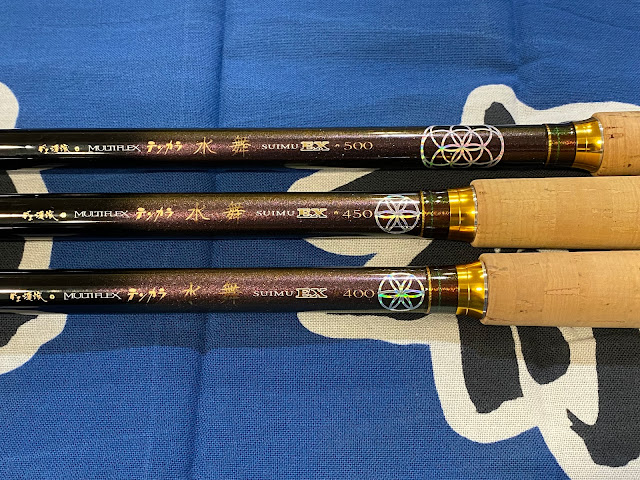
The "Flower of Life" sticker are mine and to remind me of the importance of the fish's life.

Sometimes, Dr. Tom Davis and I work together for information on equipment (the 360 Karasu in this case) and he offered to send his to me to try. I had helped him get his Sakura Seki Rei. As a matter of fact, I helped a lot of fishers get their first Japanese rod and Dr. Tom is kind in his trust with me for fishing his rods. He had written about the Suimu EX and I asked if I could check it out and he sent the Karasu and the 4m Suimu for me to try before I decided to buy one. 

I bought the Karasu.

But I really liked the Suimu EX 400.

I like the longest rod I can fish given any situation. Tenkara is a fixed length line however the zoom feature can adjust my casting distance, rod length for stream conditions, whether it be for a tight stream an open casting situation or fighting a fish, even for reaching over obstacles and currents. I've learned that a zoom is an attribute for "extra reach" as in adaptability. I use a zoom rod primarily for the effects it has on casting position rather than only for extra reach.

For many seasons I went through a realization that a zoom rod can be rendered handicapped by a broken o-ring. I had just broken an o-ring on another premium $500 zoom rod and yes, I could cast it without the o-ring but no, I didn't want too. The sections were so loose! So I passed on buying another zoom rod and I'm glad.

Let me explain.

As I got into Honryu, all the 4.5m class rods were just too soft or I didn't like the way they cast. I had a couple that were ok but the fact of my search was that each rod was a compromise to what "I" wanted in a rod. Let me be clear, I don't think my skills are better than a Japanese team of engineers with decades of experience, no, not even close. I just wanted what I wanted in a rod and what was available for Honryu wasn't pleasing to me.

I had always wanted the longest single hand tenkara rod that I could find and the Suimu EX 500 filled that niche by its lonesome, so I ordered one. When it arrived, whoa, what a beast. A 5m single hand rod has all the physics working against it. The 500 EX did make the experience as pleasant as possible but still, what an incredibly long rod. I'm not a muscular person, my arms are of average or smaller than average from a career of cardiovascular technology, I used my brain more than my arm muscles. I had flown hang gliders for many years but a performance hang glider, much like any fine tool is not a mechanism that demands strength, it demands thinking.

Casting for me started at a 6m line and I worked up to 12m and back down to 7, up to 10 and the 7m seemed the sweet spot for an all-around line. If I needed to go long, I could step up to an 8, 9 or 10m line no problem.

Casting has never been a problem for me because I practice for many years and I understand the dynamics. There is nothing tricky about casting the Suimu. It can handle me being tired at the end of the day when my timing isn't always spot on. I can still pinpoint cast it and that shows in the design, the materials that make up the Suimu series and the fit and finish is still a thing to behold in the bright sunlight of an emerald, green river bottom.

That 500 EX is where I started my love affair for the Suimu.

I bought the Suimu EX 400 next and began fishing it in the streams of the Mogollon Rim and at 3m nested length, I began to realize that this is the first rod that I really enjoyed fishing at it's shortest length. I usually just open up a zoom rod and fish it long and fold it up at the end of the day. If I come upon a section that needs a shorter rod length, I'll fold it up a little and work from there.

The zoom nesting butt cap is simple, it has plenty of hold and no moving parts. The nesting portion of the zoom proved to me that I could forget about failure and concentrate on performance.

In my practice of tenkara, I don't want a bunch of rods, that is an undesirable condition for me. I want as few rods as possible and right now, I have 7 but it's really like I have less than that. The three Suimu makes up my tenkara quiver for headwaters, the mountain stream all the way to the biggest river fish I can tackle. No, I would not go for the biggest Alaskan fish with the 500, that's a two handed rod for me. I don't do something just because I can, I want to do it in good style... I have only three rods for tenkara. I have two petite and tiny rods for opportunistic tenkara fishing. I carry them every day but they are chosen for their compact length first and most of the time, they are carried rather than used. I really have only three rods that I use for my world of planned tenkara trips. 

As I write this, my Suimu line up is complete. I just received the EX 450 and it is sweet. It is another Honryu rod or for big streams and big fish. I consider it a light honryu rod to back up my EX 500. The EX 400 is my tenkara rod in the keiryu environment.

If you are a tenkara angler that wants the best tenkara rod you can buy, this is the rod for you. Choose the Suimu size based on what you are going to do with it. The EX 400 should be your first choice. Bigger streams and bigger fish? Go for the 450, want to catch the largest fish in your river? Choose the 500.

I line mine with soft, premium clear fluorocarbon with a size rating of #3.5. I sometimes custom make lines for it but it's really not necessary.

I enjoy the faster tip action of the Suimu, they are in the 6:4 to 7:3 flex profile with lots of carbon fiber in the matrix so you have a particularly faster rod than say a full flexing Nissin. The faster action suits my chosen casting style over a Nissin 4.5m Sakakibara designed Zerosum which is one of the rods in my minimal quiver. I do use that rod extensively but not in the environment that I use the Suimu.

If you want more detailed information on how it casts, check out Dr. Tom's look at his quiver. His writing is far more detailed in this genre which I'm not interested in writing about. I'm more about chosen methods and why I choose a particular rod. 

Suimu EX 400 - 450 - 500


Siumu EX 500 caught Colorado River Rainbow in Glen Canyon

I can tell you this, the Suimu EX 500 casts excellently and feels good at it's 4.2m length. If I need some reach while manipulating the kebari or fly, I can lengthen the rod. I cast it almost exclusively at the 4.2m length. I have spent many days now on the Colorado river in Glen Canyon catching fish up to 22" in fast river flow and this rod has the ability to subdue and move those fish on 5 - 6x and I have even pressured big fish with 7x.

In the San Juan river below Navajo Dam, I am able to do the same thing. Large fish can be handled with this rod. 

This rod is quickly becoming my favorite goto river rod for big fish fighting skills.

Tenkara Techniques for Slack Water Trout


There are many techniques in fishing for still water trout that directly transfer to pools and slack water on rivers and streams. In my area, I am fishing tenkara in a variety of water from one foot wide 3 cfs streams to a hundred yard wide river and 14,000 cfs flow. I also fish winter stocked urban ponds close to my home. I’ve fished these urban ponds for trout over the years and the knowledge that I have gained along with fishing for trout in lakes directly relate to trout in pools and slack water in rivers and streams. 

The trout are the same however the approach in catching them needs a little adjustment. 

Trout in still water feed on the move and their behavior is based on finding and consuming food in a static environment while trout in streams and rivers find and take food in a dynamic moving environment. 

The key to approaching and catching trout in a static environment is to find them first.

I live in the desert southwest. I have to travel by car for ninety minutes to get to my closest watershed. In the winter, the cooler daytime temperatures allow for stocking of trout in city ponds and urban lakes. My long travel to go fishing now becomes a ten minute drive. During the winter, I primarily fish still water using tenkara techniques for a couple of months. I continue to hone my tenkara techniques based on those many days of fishing for still water trout. I call this type of urban fishing #untenkara.

What I have found is this type of fishing directly transfers to fishing for wild trout in pools and slack water found on streams and rivers. This convenient urban setting relates and actually helps me catch the most difficult trout in gin clear and shallow pool water in the wild.

When I fish a stream, I approach a section with care and look for structure. The flow state in a stream indicates to me where the fish are. I look at the gradient, the depth of water and the structure, how it creates the flow or I look at the flow itself and find the fish by knowing where they will hold to feed in relation to rocks, bends and structure. Trout will use the flow like soaring birds to stay in one place as the food source “flys” by in the current. The trout use very little energy in intercepting bugs to eat and fill up the tank that fuels their engine. If I do not actually see the fish, I imagine where they should be in a feeding lane or in a spot in front of a rock or behind it holding in the pressure wave. Or I will imagine them under a root ball in the flow. I will present my kebari in a methodical approach based on many years of tenkara fishing in relation to the structure and flow. I’m actually fishing structure prioritizing where I place my first casts.

When I fish a pool, I begin with a completely different mind set. Ever before I approach a pool in the wild, I’m using stealth, viewing the pool from far away, I’m looking for any signs of current and or the relation of the pool in the stream or river. I want to know where the pool is filled and where is the outflow. How deep it is, where is the deepest spot and what is the temperature. Where is the sun in relation to the pool? Is there any cover or shade?

Do I see fish actively feeding?

I assess the pool ever before I reach it, I find the fish and decide my method of approach.

Just as I fish a stream, I move upstream and approach pools from the outflow. In big rivers, I approach perpendicular from the bank.

Trout in pools typically have three types of behavior. They sometimes move in pods or groups from one place to another feeding here and there. Other times they will be dispersed through out the pool feeding selectively on their own. The will also hold to structure in the pool. If there is a varying temperature or gradient, trout will often seek the depth where cooler water is during the middle of the day.

Before I approach a pool a glade or slack water, I observe from as far away as I can, where the fish are, I find them first and then I cast to individual fish or if I see evidence of where they are, I will cast to rise rings or swirls. Pools, slow moving or still water in rivers are typically in an open environment. On a stream, a still water pool, a slick or a glade often is lined with vegetation and or trees with overhanging limbs. For all my tenkara, I use the longest rods and lines as possible. For still water where trout often have time to inspect what they eat, I will use clear fluorocarbon lines and finer tippets down to 7x. Stealth is key and even approaching the pool I will move slowly and pay attention to my foot steps not clacking rocks together or splashing as I move. The long tenkara rod and light line allows me to present to the trout in more of a vertical orientation with very little line disturbing the surface. Tenkara presentations are often “fly first” the line at an acute angler going in to the water with no line slap disturbance on the meniscus.

To review, asses the pool, quietly move into position and make your tenkara presentation in a super stealthy method with no distractions to alert the trout. This is key to successfully fishing this difficult water. 

When you catch trout in a nearly invisible pool of still water, you know you are doing well.

So I approach the pool after figuring out where the fish are and work from the closest trout to me outward. If I know the trout are nervous, as in if I scare one single trout, it will run and put the pool down, I will approach very slowly and deliberately and cast lightly. Precise pin point casting puts the fly close to the trout and often the take is immediate in pools. If I am able to see trout rising, I will cast a little beyond them and depending on the type of fly I have, I'll let it sink for a second or so before beginning to pulse the fly. 

Even in very selective water, I am not matching the hatch. I use a favorite fly that I'm confident in. The fly doesn't seem to matter, it's the stealth that matters with tenkara presentations, not matching the hatch or dead drifting. It's the fact that the trout are not alerted to your presence first. Your fly is an opportunistic meal and their attention is fully focused on feeding.

Fishing a 4-5 meter rod and a 7 to 10 meter line is in the neighborhood of 40 feet of reach. Casting at that length, I am not able to see my fly, let alone a clear fluorocarbon line. Much of what I am doing with the fly is by feel. All of my still water fishing is sub surface and most of the takes are felt or indicated by the line movement. There are times where I am so in the moment that I feel like I imagine fish. From those many days of watching my line and feeling my fly rub along the bottom, I am indicating subtle un-familiar line movements and or tiny telegraphed rattles of the lines as fish taking my fly and turning. 

I'm so in the zone and comfortable with my equipment that it seems as if I am imagining the takes that catch fish.

I am. 

That imagination of what my fly is doing gives me the cutting edge to set the hook on even the slightest change in the way that the line is behaving or in the feel of the rod. You learn to let go of thinking and start being mindful and in the moment. 

I don't think of fishing, I imagine catching.

Fishing in an urban environment allows me to inspect each and every aspect of my casting, presentation and pick up and cast again. While retrieving the fly, I am concentrating on my casting hand, what it feels as the rod tip loads, how that feeling changes, how the line drape changes as I tighten the line and pause. I have time and repetition, over and over. I keep my body in the same position, I am a machine, my body in the same position, everything the same, methodically, over and over making the same movements. Through this methodical and repetitive movement, I am able to discern the line movement and more importantly, any different movement in the line, SET!

It's this methodical approach, this repetition of casting and moving the fly, over and over the same way that I believe is the success to my understanding when to set the hook in difficult still water.

I would say that there is no magic in it but the truth of it but there is. 

How do you explain to someone this magic?

The above is the best that I can do.

Set yourself up with a method that is the same every time. Remember this method, do it the same way every single time. 

A methodical approach promotes a sixth sense for catching.

I used to wonder why watching a successful Japanese honryu angler was robot like. He moves from one area to another sampling holes, runs and holds with the same cast, the same rod angle, everything the same. It appears that he is mechanical in his cast, retrieve moving on, doing it again and again in the same fashion.

The whole rod line and fly is the indicator, the system to tell you that the fish, beyond your sight has taken the fly. The fish's mouth is small, the fly even smaller but the line is big, the rod is too, put it all together and you have a system of indication of when to set the hook.

I've written it before, it's the software of tenkara fishing that catches fish. You can stack the odds in your favor but if you aren't keeping touch with the fly, you will miss the opportunity to observe the subtle facts of the take, the feel of the line and the fluttering of the fish's tail.


New Honryu Tenkara Season


Arizona has a lot of different types of rivers and streams to explore with a tenkara rod. Our state is not all desert, it has the largest ponderosa forest in the United States and in that forest and the mountains lies hundreds and hundreds of miles of streams and trout!

For the last several years, I’ve been hiking and exploring those streams with my tenkara rod and before that I used my fly rods. As I enter this next season, I’ll focus more on my big water tenkara techniques.

I enjoy using 4 - 5 meter length rods that are powered up for bigger trout and the flow they live in. These rods are stiffer, take more effort to cast and by design, they present more surface area resistance to the air during its casting stroke. 

The lines I use are longer and slightly heavier gauge and in my case, clear. The river I fish is so clear that driving along upriver in a powerful shallow draft boat, you still have to know where the river channel is. It can go from 15’ deep to 1’ shallow very quickly, the water so clear, the depth appearance not always true.

I use a pack raft to get back to my car floating many miles and along the way, there are times the trout appear to be suspended, the surface and the water so clear. My friends in their boats seemingly flying along above them.


This will be what I consider my second real season of honryu tenkara. My first two seasons were spent flailing the water, trying to figure out how not to fly fish with my tenkara rod.

I’ve always said that a good rod knows what to do, you just have to listen and watch what it does. That’s the way I learned honryu. I took a few rods and tried everything and then I bought a purpose built rod and upscale a line for it and listened to it sing. 

...and the song it sang was beautiful.

Prior to my learning tenkara, I had caught thousands of fish on this river and in this very spot. Initially I set up my rods like a western fly rod (sans reel) with floating lines and indicator, split shot and fly, dead drifting slack line waiting for the bobber to do its thing and it did but it wasn’t working. 

I was catching fish but the count was low and landing them was even worse.

I even bought a performance 5-weight and spent an afternoon revisiting my fly fishing past.

It was not fun, it was frustrating, I was going backwards, I knew tenkara was better.

So I sat there in my camp chair, dejected. I ran through many scenarios in my mind. I knew I had everything I needed but I wasn’t putting it all together, “why” I asked myself, “why was this so difficult.” I had caught so many fish here, I knew fly fishing, I knew tenkara, why couldn’t I get my fish count back.

At the time, I just had no idea what to do.

So I just stopped with the notion that it was the fish count and concentrated on catching instead of counting.


I picked out a fly I had confidence in and looked at the water straight in front of me and began with an overhead view.

“Where are the fish.”

I was on the inside of a big horseshoe bend. The back eddy in front of me was massive, the bottom was sand, there was a submerged tabletop of salad (aquatic vegetation) and I could see trout milling on scuds on the far side in the main flow. I moved slowly within a cast and reached out upstream across the counter current and drifted my fly off the salad ledge and dropped into the zone.

My line was tight, I gently pulsed the fly and two trout pointed toward toward it.

“Yes, I have their attention, so far so good.”

In a smooth motion I picked up the entire line in one piece and directed it forward upstream. I was the center post on the second hand of a huge clock, my rod sweeping in slow motion, my line matching the speed of the current. I could see my fly far away, 5 meter rod, 8 meters of line, I really couldn’t see it but I imagined it. I could feel it ticking on the bottom between pulses. 

The fly going over the salad ledge, lower the tip to sink it and lift to pulse and my line is rattling, yess, set!

“Fish on!”

Backing up, playing the fish, net out, hand line net, release and tuck the net in my belt and forward again back into position.

My position in the second hand nailing yet another trout, and another...


It’s backwards, it’s not a slack line, it needs to be tight.

I was fly fishing, that was the problem, I had the wrong software loaded, time to delete that old program and trust the new software.

And that’s exactly what I did, instead of staying in one spot, it was time to move.

I lifted the rod, looped the line and grabbed the fly walking back to the shore and at the edge back upstream.

I had caught a few fish quickly, faster than if I had a fly rod and the gig is, I could not have reached those fish and manipulated my fly as I did with a nine foot fly rod.

Upstream I saw fish dimpling the surface taking midges. Ok, lots of fish. I thought to myself, “I have some size #22 midges” and then remembered the software.

Creeping into the shallow water, I began to take note the slack current nearly like the still water ponds fishing for stocked trout. Shaking the line loose from the rod, holding on to the fly casting the bend of line upwards releasing the fly and casting forward stop!

My fly stretching the line taught just past a rise ring, pause, lift, pause lift and TIGHT!

“Fish on!”

Again and again.

It wasn’t the hardware, it was the programming.

Load the program and let the software do its thing.


Honryu Tenkara

Photo by Siegfried Forster
My tenkara is based in the mountain stream environment yet I enjoy fishing the mainstream. Apparently I am in the same class as many Japanese anglers as they also take their tenkara with them to the river. They use long (4-5m class) single hand rods using tenkara techniques to catch river fish. My experience in fly fishing rivers is long and intense, my practice of mountain valley tenkara is extensive and my honryu tenkara is starting now to develop to the point where I can share it now. I will put down some of my thoughts on setting up my equipment and using it.

Photo by Siegfried Forster 
In my area, I choose a large cold water river that I use my tenkara techniques. My favorite is a tailwater or a bottom release dam on the Colorado River in Northern Arizona. There are other rivers here that contain trout but they are more like large streams in the mountains so I will focus on my practice of honryu tenkara in the Colorado River in Glen Canyon. My access to this river is difficult, there are no roads in the canyon. I travel upriver by backhauling in a larger powered boat, dropping me off to camp and to return the many miles back to the put in by a small but efficient inflatable raft

Photo by Siegfried Forster 
I practice minimalism, only what I need. I may use sasoi, dead drift nymphing, dry fly midges, big cicada presentations and streamer fishing in moving current as well as deep slack water.

For now, I will use this project to gather my thoughts into an organized system and work from there by returning to these thoughts and refining them. I do this with my pack lists up in this canyon by only using what is on the list and striking out items that I do not use and packing again only what is left in the list.

This keeps me focused.

I use only one rod, the Gamakatsu Suimu EX 5m, a long cork handled single hand rod that is exquisitely designed to cast a long level line, I use a #3.5 to have a little "punch" into the swirling canyon winds of the afternoon. The fish in my river are heavily pressured by spin fishers ripping spoons and streamers and also guided fly fishermen as well as adventuring anglers such as myself.

Rigging lines, I always use my little kit 
Part of developing good tenkara skills is making your own equipment. Of course you can purchase nearly all of what you need from the many vendors available however, there is not a lot available that is marketed to this genre of tenkara. So I make my own lines, clear lines which go against the marketing of "lines that you can see" in pink, orange and fluorescent green or bright and muted colors. The fish I am after are pressured and wince at a large pink moving thing above them in the ultra clear water against a sky that has no direct sunlight, the river I am making these lines for is in a thousand foot canyon. Currently, there are no lines for this application.

Seaguar INVIZ X .330mm which equates to #3.5 Valcan
I do use a Fujino Soft Tenkara 7m line but that is rare in this river. If I do not use it this next trip, I will remove it from my kit. This is how I hone what I use, attrition, if it does not get used, it is removed. I also have a light fly line that I use for specialized situations. There are dry fly midge hatches that a fluorocarbon line at length will pull down a tiny size #22 midge dry. So I use a floating line. In the summer, there is a cicada hatch that is incredible to behold and using a fly line for plopping down a large bulky fly works really well. A fly line has demanded it's way into my quiver and I have no problem using it. It even fits into the definition of tenkara in Japan.

I use card spools as they are flat and you can stack them
The bag I use is a little larger than a tenkara strap pack. I have a tenkara box and a highly specialized box of flys that I have developed for this river over decades of fishing it. The tenkara box and the fly box fit into this bag as well as the many different lines and pieces of kit that I use.

It is funny, the quote I use, "the more you know the less you need" is from Yvon Chouinard and his company, Patagonia offers this "Wader Workstation" bag and it's twice the size of my tenkara bag. What is funny, my tenkara bag is half the size of this bag, I am much more experienced at tenkara in the mountain stream environment. My honryu tenkara is in the intermediate stage and I am still in the research and development throes. I am developing my techniques so I carry more, as my skill is strengthened, I will carry less. Right now, I carry far less into the canyon than I ever have in my 30 years of fishing here. 

I put everything in this kit which I can use as a strap bag or hang on my waders
My kit list is as follows.

Gamakatsu Suimu EX 5m

Seaguar Inviz X .330 7m line (tippet ring) x 2ea
Valcan #3.5 7m
Valcan #3.5 5m with markers
Fujino Soft Tenkara Long Type 7m
Floating Fly Line 8m

Dinsmore tin shot
Nipper on a fly line
Derf Needle Driver

Micro drop floatant (Gink)
Un-stick pads

Trouthunter Flourocarbon 5x - 6x - 7x

Wheatley Medium Black ripple foam fly box and specialized flys
Orvis Waterproof Compartment fly box with specialized flys and kebari

New Zealand indicator kit
Arrow indicator

Patagonia Middle Fork Packable waders
Patagonia Wader Workstation


The primary fish of the Colorado is a couple of different types of Rainbow trout with small numbers of Brown trout and even smaller numbers of Brook trout. There are a few different types of chubs and a couple of types of carp that live in the river. Almost all of the time you will catch two types of Rainbow trout with a rare catch of a Brown.

There are three basic presentations.

Drifting the bottom.
Sasoi in the water colum
Surface type

The techniques I use in the Colorado River in Glen Canyon have been developed from a knowledge of where the trout are depending on the varying flows released from the dam and the time of year or the amount of sunlight that affects the floura and fauna of the area. I choose to break up the year in seasons to make it easy. When I write about fishing there, I tag the title with the month of the year so I can refer to the article to others to know what to expect. Starting with winter, the rainbow trout that are my primary target are in the spawn. The females have made "redds" or depressions in the rocks and gravel and stay there protecting and nurturing their eggs. As we move into spring, the insects are starting to proliferate with huge hatches of midges or tiny black and white flying bugs that are larvae in the water (nymphs) and hatch out of the water. Summer can be a time of terrestrial fishing with grasshoppers and the cicada hatches, fall is a time of the start of the spawn. Through out the year, depending on the flows, there are scuds or tiny fresh water shrimp type bugs, tiny worms and small fish or streamers.

The purpose of this article is to begin separating my writing into the different areas that I practice tenkara, one in the mountains and in the headwaters and two, in the mainstream. I also practice tenkara techniques in ponds and lakes. Although this is not typical moving water, I do use the techniques of the rods and equipment there. 

Patagonia Middle Fork Packable Waders

Patagonia Middle Fork Packable Waders are by far my favorite waders I've ever owned. I have owned many pairs of Simms, at least two pairs of the Simms guide pants and multiple Simms chest waders. The Middle Forks are light where they can be, strong and light were they need to be and tough in high wear areas.

I don't work for Patagonia, I don't receive any gifts from them, I bought all of my gear full price just like the rest of you. I'm writing this endorsement because they are worthy of my hard earned money and my favorite time on the river and stream.


The foot on the wader is a sort of rubber, not a wetsuit material but a rubber sock so to speak. I put my waders on fast and pull up on them getting the wrinkles out and I wear thin liner socks on the inside and my feet don't get cold and the wader sock does not bunch up. They work really well. I wear them with wetsuit booties with a felt sole or with my sawanobori boots, they both work like it was meant to be.

When it comes to packing them up, I just take them off, lay them flat, roll 'em up and stuff them in the nice stuff sack. They end up being about the size of a 1 liter nalgene water bottle. That's with the included wader belt. For packrafting or a minimalist traveler, these things are so nice to wear, pack up small and are tough. Were I fish, I have to do some hiking and through the brush and these waders have stood up to it so far.

I am not a fan of waders, I prefer wet wading yet at a tailwater, waders are a necessity. If I'm traveling, they do not take up much space at all and I can throw them in a small backpack and use them with packable wetsuit felt sole booties or rubber sole boots.

The wader workstation works well with this system an allows me to have many choices in the way I approach my streams or rivers.

Packrafting Glen Canyon (March)


March is a time of unsettled weather. Fast moving fronts move through the area. The thousand foot cliffs will funnel wind and create standing waves on the river, unable for a packraft to make progress back to Lees Ferry.

The weather is very important to consider when planning a trip in the canyon.

Everything I take upriver, I have to bring back on my raft.

Packrafting is a exercise in minimalism and March is going to be interesting with the cold and possibly windy weather. Two weeks before our trip, we had a powerful storm front that affected the state with record snowfall. But at this time, the weather is warming clearing and there is a warming trend, it's looking good so far...

On this trip, Siegfried Forster will be joining me. He and I bought our packrafts about the same time. He is in town and March is a little early for me but I want to guide him upriver the first time and also spend time fishing with him. I meet him at a Tenkara USA Summit and he is a really nice guy.

Last September, I sat there sweating, cowering under the small tree from the intense heat radiated and focused on me from the giant lens of the river bend horseshoe, I began to look at my excess equipment, shit that I brought that I just didn’t even use or need. It wasn’t a big mistake but it did not add to the experience, it was taking away. I have to stuff, pack and paddle it back.

I’m not going to make that mistake again.

On the very iPad that I generated the first pack list, I brought on that trip and used to trim the first list at my camp on the river, I am typing this note at home, I’ll be leaving the iPad at home, only what I need...

It’s hard for me, I am a minimalist. My pack list is under constant scrutiny. This process is augmented by actual usage and on-site follow up.

I don’t need stuff, I only need what I need for a light, fast solo trip.

There are special considerations depending on the season. The temperature can swing from snowy in the morning to a sunny afternoon in a t-shirt. It can be super hot during the day, check. Freezing at night, check. Surrounded by clean cold water, I do not need to bring more, I need to trust my equipment and filter my drinking water. I don’t need to bring extra plastic along.

Pack rafting back out of the canyon is fun. The trip back is through time, literally through unfathomable depths of a deep sandstone canyon. When I do relax and focus on my craft, it is affected by the weight of all the extra stuff I didn’t need. The raft wants to swap ends in the gentle breeze, the nose is weighed down and I’m reminded of my inefficient planning.

I’ll get good at this through practice.

Go through the list again, you are not allowed to add to it, only take away.

I could leave the headlight at home but at night, I need to see. The solar light is a must, it provides a small but comforting circle of light. I need a back up source... Ok, my iPhone has a flashlight, take away the headlight!

Dinner, check the Mountain House web site, beef stew sounds good.

Check your notes again, ok. I need to inflate my boat before I am backhauled. I want to drop off my bundles of firewood and continue on upriver to do some fishing then float back to my camp. I don’t want to wast time upriver blowing up, this will save some time for fishing.

Thinking it through, on the backhaul, how does my kit get moved? All camping gear in the waterproof bag, my cooler, pad, paddle and firewood are loose, that’s ok, firewood, waterproof bag (all camp goods) get dumped off at 9-mile and I’ll go a couple more miles upstream to fish and fool around before paddling back to fish and to set up camp.

That’s good.

I wanted to do this last time. The logistics are doable.

Figuring this stuff out is fun. It isn’t overthinking. My travel is all downstream. I can’t paddle upstream, the current is too much. So thinking about how to maximize my ride upriver is a big part of my route planning. I only get one ride up, don’t blow it.

Photographs, I didn’t get any of my packraft last time. No big deal but I want a few for my friends here this time. I will set up the Nikon on the tripod and do it that way. I’ll have to make a note for myself to do that.

Check.

Almost here, counting down the days...

I remember really enjoying watching a movie on my phone. I didn’t remember to check the uploads, they got moved to the cloud, let me check the phone now and pull one down to watch or rent. Upload “The Force Awakens” looks like I’m watching a Star Wars movie!

I’ll add to this tomorrow and the next couple of weeks before I go. For me, trip preparation is fun and almost as important as the trip itself.

Glen Canyon Weather for March: Expected daytime highs 60, lows 37


Packraft, paddle, stow bag and pfd

Tent, sleeping bag, pad, chair, cooking, water, light and food

Clothes and personal items

Fishing boots, waders, fly and tenkara rod with pin soles and fishing kit

Pack list for March Glen Canyon camp and packraft x 2 nights

Sawer filtration kit
Platypus 1 & 2 liter

Fat wood
Firewood x 4 bundles
Fabric sink

Stove - Gas Cartridge x 2
Snow Peak Table
Long Spoon
Sierra Cup
Cook Pot

Pack Raft
Inflation Bag
Paddle
PDF
65L WP bag
String Attach Kit
Bow Bag
Patch Kit

North Face Tent
Pad - Quilt - Pillow
Monarch Chair
Solar light

Hat, Buff, Fingerless gloves, sunglasses
Wading boots
Waders
Tent booties
Pants
Capilene baselayer top and bottom
Liner Socks, mid weight socks x 2
R-1 Hoody
Puffy jacket
Rain jacket
Umbrella

Medicine bag
Baby wipes
Small Towel

5-weight fly rod
Fly box pack

iPhone - extra battery
Monocular
Stuff backpack

Dinner (rehydration meal plan) x 2
Breakfast: scrambled eggs, coffee x 2
Snack: trail mix

Notes: Strike through are items that I brought but did not use or could get along without.

Tenkara-Fisher: Packrafting - Salt River - Glen Canyon 


We used Lees Ferry Anglers backhaul service. Terry Gunn's fishing guide service has been operating there forever. They love the river, their customers and they care us. Although I know the river well, Terry knows so much more than I can imagine from working within Glen Canyon for decades.

Our trip was in-between rain and wind. We had perfect weather for the entire trip.

Our paddle back was quick and without event.

I used the honryu 5m rod and caught a couple of fish, my five weight western rod, I hooked into and played one for a while and it shook the hook.

We hiked and enjoyed our stay at 9-mile and I will be back soon with more friends and family.


Motoring up river with Lees Ferry back haul services in style


Packrafting Glen Canyon (September)


One of my favorite spots in the world is right here in Arizona, 9 miles upstream of Lees Ferry on the Colorado River in Marble Canyon. The only practical way to get there is on a boat with a captain that knows the river channel. You can't hike to it, it's at the bottom of a deep canyon on the isolated beach bend of a huge western river. The river beach where I will camp is at the famous “Horseshoe Bend” that I have and many tourists have taken pictures of from above on the cliff top, about a thousand feet above.


I’ve been visiting this place as a fisherman for many years. I was introduced to it by one of my hang gliding friends. We would sit around the campfire after a great flight and he would talk to me about this place that was so grand, the soaring cliffs, the ice cold river and the big trout that cruised it’s depths. Here we were on a hang gliding weekend and we were dreaming about camping and fishing at Horseshoe Bend in Marble Canyon.

I finally took him up on his offer to take me there. It was in the early 90’s. I took ten days off, he said that if I was going, we needed to live there for a while to really experience it and that is exactly what I did. It was in February and the boat was loaded up to the gills with mesquite firewood, two ice chests of food, our tents, chairs and all the things necessary for a week plus fishing trip. We drove the four hours North from Phoenix, launched the boat, parked the truck and motored upriver for nine miles to a life changing adventure.


The Colorado River carves through the sandstone earth of the area. Glen Canyon, being just like the Grand Canyon but farther upstream is just a little smaller. The cliffs in this area are about a thousand feet tall and straight up from the river. The river meanders back and forth in this area below Glen Canyon Dam which creates Lake Powell. This dam was completed in 1963. The diversion tunnels were blocked and the beginning of Lake Powell began. Being a bottom release dam, the water is cold and habitable for big river trout.


At nine miles upriver, there is very little sound, maybe a guide boat motoring upriver now and then but only a few times a day, otherwise, silence. The water in all its immensity is flat through the canyon with a few riffles but it’s quiet, really quiet. Being at the bottom of a slot canyon on a grandeur scale, sound, when it happens is amplified and it is also really quiet at the same time. Depending on the time of year, sunlight may not reach the river. During my 10 day stay on my first trip there, a block of ice left by someone prior to us did not melt, it was bitter cold, I wore a snowmobile suit the whole time I was there. During the summer, the temperature is very hot at 100 degrees while the river is cold at 47 degrees.

This is a magical place of extremes.

Camping at the Horseshoe Bend is an experience to remember. You can only get here by boat. The cliffs go all the way to the water. From the camp, the only people you will see are those motoring upriver or the anglers fishing your area. If you look hard at the top of the cliffs on the other side, you can see the tourists viewing the immensity of the horseshoe bend. It's a popular place but it isn't hard to feel small, desolate and alone.


But there is another way to the spot, being backhauled by the big river inflatable pontoon boats that are run by tourist groups for visitors. They sign up for float trips down river from the dam. When they reach Lees Ferry 14 miles down river from the dam, they beach, let the tourists out and motor upriver alone. The tour companies have figured out that there are people like me willing to pay for a ride back upriver with our packraft, kayak or other personal watercraft to float or paddle back to Lees Ferry only to get out and drive back home. If you miss the put in, you are in for a rude awakening. Downriver of Lees Ferry is world class whitewater. 

Don't miss the boat ramp.

I'm no stranger to the area. I've been upriver countless numbers of trips since my first stay. I've camped at the Horseshoe Bend or "9 mile" as I like to call it many nights. I continue to go back for camping and fishing, lots of three and four day weekends and several one day upriver forays. I've crashed boats up there in the silence of daybreak, had 100 fish days where a small fish was 12" and my largest trout there ran about well, pounds, four pounds or so, big.


My respect for the river is as deep as it is powerful. I've been knocked out of the boat by the captain hitting a submerged boulder the size of a travel trailer only to nearly be run over by the boat. I've been smart enough not to be swept downstream by rising water, yes, the dam fluctuates from 7,000 cubic feet per second to a pretty regular high of 14,000 cfs. You must get creative in beaching your boat by placing a couple of anchor lines if you don't want the boat stranded on dry sand when the power generating flows are down.

The focus of this story is not about that, it's about taking on this river in a much more simple craft and fishing it with a tenkara rod. I'm taking my packraft, being hauled upriver with it and some firewood, dumped off and living for a few days, living and re-living, fishing, napping and dreaming.

The drive across the Navajo Reservation is desolate and stark in contrast to the forest of Flagstaff

Navajo Bridges, you have to cross the Colorado to get to Lees Ferry

I have no idea why this guy was down here

The Vermillion Cliffs

Headed upriver, they call it "back haul" and it takes about 45 minutes to get to 9 mile

On the way upriver

My ride upriver driving the rest of the way to the dam at 14 mile

Set up camp and relaxing

I use a block of ice, it lasts longer

Going for a hike

Felt sole tabi work well for pack rafting, wet wading and a little hiking, the felt grips the sandstone that you must climb

Looking back at the horseshoe


A picture through my binoculars 

It's amazing how people will just back up to the cliff to get a selfie

Minimal camp kit

These guys got into my bread, note to self, hard container

Headed just downstream from 9 mile, on my way home

Finger rock on the way back


The river is like glass in some places but you are zipping along


Looking back upriver, that's all my stuff in the yellow bag, about 35 pounds

Almost to Lees Ferry

That's me, about 20' deep, super clear water

On the way back, that's the San Francisco Peaks where Flagstaff is

Pack raft, pfd, dry bag and stuff that goes in the bow bag

Tent, tarp (did not take) quilt, chair, pad etc

Food for four days, I took half, I did three days, two nights

Lees Ferry (web page I created from 1998)
Resources

Lees Ferry USGS Current Flow
Patagonia Simple Fly Fishing

Some of the Equipment used

Alpacka Packraft
Mountain Laurel Designs Duomid

Packrafting on Tenkara-Fisher: Packrafting - Salt River - Glen Canyon