|
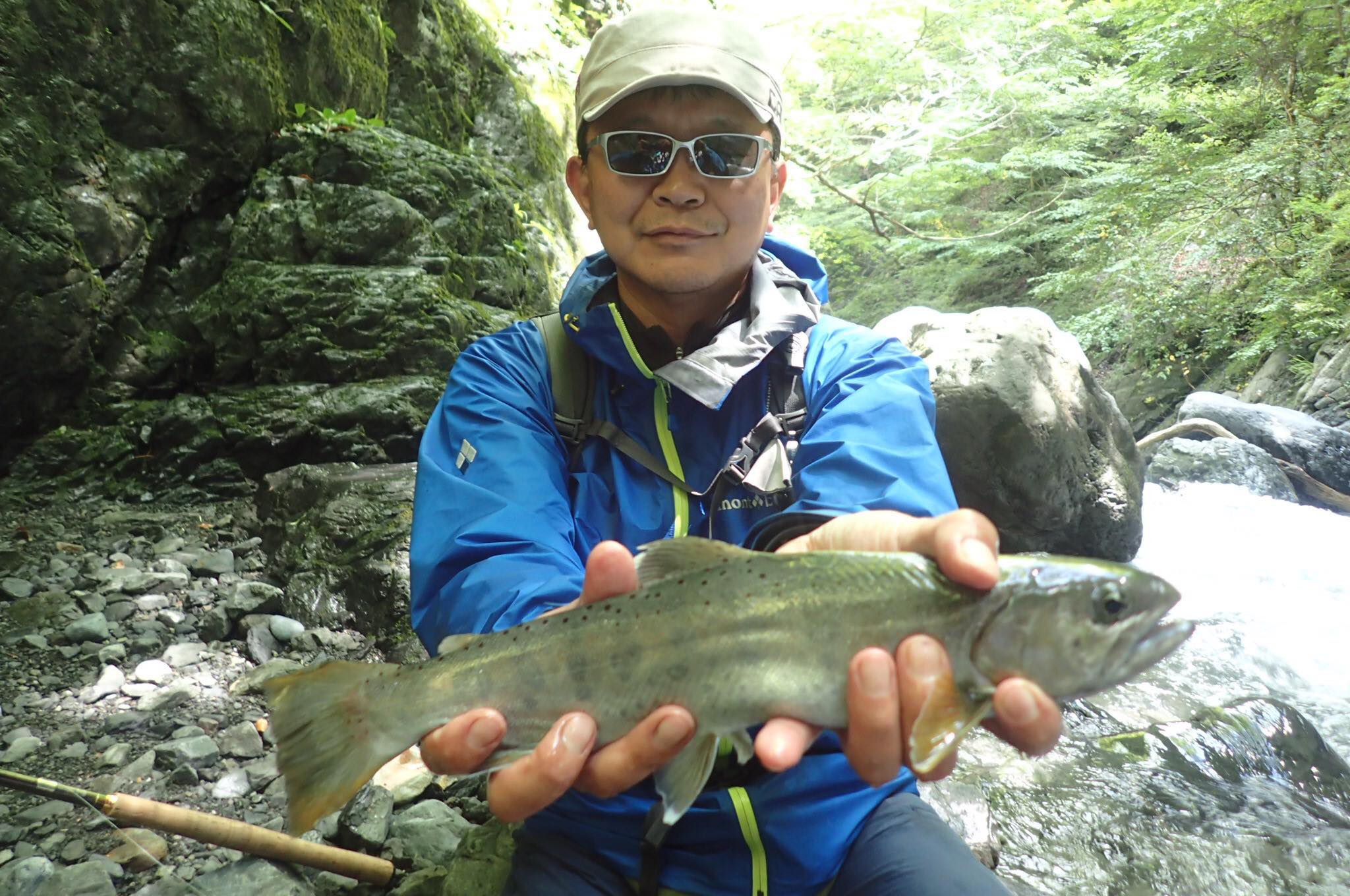
| Yoko and Shouetsu Goto |
Thank you for taking the time for this interview. I was planning it, but I wanted to give you a little time between Yoko san interview. Now, I am able to introduce you with a unique introduction. I am so happy to be interviewing both of you now, especially since your new book is out.
First and foremost, thank you again for your time.I have been to Japan three times, but last time I visited many friends at Tadami Bansho. I have been taken on several fishing trips in the valleys of Japanese mountains. We hiked long distances, not only eating at camp but also climbing and route finding. My backpack was unusually heavy, wading, hiking and climbing was a bit of a challenge. My friend said it was a little easier than their trips, but there was one time I was going up a vertical mud wall that was undercut at the bottom. Thirty feet up and it was vertical. The last ten feet I was skating, and I felt like I would get hurt if I slipped and fell. Luckily, I had a few friends who looked after me.
Anyway, no one in our group slipped and it turned out to be an epic trip that I still remember clearly. Your style of fishing is inspiring, and the effort and special equipment is required. I realized that your headwater fishing is on a different scale compared to fly fishing or tenkara in the US.
So, I appreciate what you do.
I watch all your videos! Several times! They are great, and I know in another life, I was one of you!
I bought your book Genryu Izakaya and I love it. I have already discovered a good knife, the G. Sakai, which I currently own and use in my camping kit and at home. We also found nesting wooden bowls from Vidahde. This is very convenient for hot food and very aesthetic. There are good things about your videos and books, like here in Tenkara Fisher's Origin Story.
Anyway, thanks for all the great resources.
First of all, I admire you both as a couple and as individuals. You are very resourceful. I'm glad your house is tidy and your pub is open!
"How did the idea for Genryu Izakaya start?"
Shouetsu Goto: My wife named it Genryu Izakaya because I cook food that looks like an izakaya. After that, I started making videos on YouTube because I felt that I couldn't convey the fun with just photos on social media.

Adam Trahan: Your YouTube compilation is a perfect blend of tenkara, genryu, backpacking, tenkara, temba and cooking!
I really like your channel.
"I heard that you are also in Japan's Headwaters magazine, can you tell us about some of the articles in the magazine?"
We do not introduce the name of the river to protect the fishing grounds of the important headwaters.
That's why I don't get many requests for magazine interviews.

Adam Trahan: There are a lot of big rivers here in America and many of us do mainstream tenkara.
“Do you practice Honryu?”
Shouetsu Goto: Unfortunately, many of Japan's mainstream rivers are man-made, such as dams, and the water is not very clean. I like fishing in the great outdoors, and I also want to go camping, so I often go deep into the mountains.
Adam Trahan: One of the things I do is packcraft and honryu fishing in the big canyon rivers. The water is cold! The canyon is beautiful, and I have continued to enjoy it over the years.

"Please tell me about one of your ideas for a perfect fishing trip?"
Shouetsu Goto: Our fishing trip includes fishing, wild vegetables, mushrooms, sake, bonfires, and camping.
There are so many things to enjoy, so even if fishing isn't your thing, you can still have fun.
We always look for new fishing spots, so it is not always possible to catch fish. That's why I started cooking delicious food and enjoying sake.
.jpg)
Adam Trahan: I really enjoy taking people to river canyons. Everyone says the same thing, "EPIC", laughing and enjoying the experiences and memories together.
"Do you like to bring new people on your trip to Genryu?"
Shouetsu Goto: I would like to introduce new people to the wonders of Genryu and the joy of fishing. However, headwater fishing requires "physical strength" and "mental strength" of course, but you also need knowledge and skills to protect your own life, such as climbing and sawanobori. Taking a beginner is very difficult.

Adam Trahan: I'm not a teacher, but I enjoy sharing the fun of tenkara with people. I will teach many people how to do it, but I do not consider myself a teacher or a guide. I was getting paid to write about tenkara for a while, but it wasn't the best time ever. The best time is being with other people I don't have to teach and enjoying the experience together.
I can't read Japanese, but I can understand picture books, and if I have any questions, I have friends who can read Japanese and help me.

"Can you tell me about your book? Is it an educational book, or is it just a recipe for what you do and what you experience?"
Shouetsu Goto: Genryu Izakaya is not an educational book. However, for those who want to go headwater fishing, there is information that is necessary for people who want to go, such as the know-how to transport food deep in the mountains without spoiling, and the introduction of special tools. Of course, there are nearly 150 recipes that anyone can easily make delicious meals.
"Are you planning to write any more books at this time?"
Shouetsu Goto: If the publisher requests it, I will. There are still things we haven't talked about with our original know-how and new recipes.

Adam Trahan: I started to write a book about tenkara but I decided against it. I think I would rather it be a sort of mystery, what my idea of tenkara is. There are a few books in the English language about tenkara. My favorites for gifts or suggestions to new tenkara anglers are one from Daniel Galhardo and the others are from John Pearson and Dr. Paul Gaskell. The other books which I have not listed, I have not read. I don't think I can do a better job than Daniel, Dr. Paul and John, mine would just be different so really no need or desire to write a book from an English language point of view.
What I enjoy most now is using my computer to create websites that reflect what I do and what I am interested in.
There are many tenkara books written by Japanese authors that would benefit the tenkara community outside of Japan if they were translated into English.
"Do you have any plans to translate your book into English?"
Shouetsu Goto: I think it will be up to the publisher, Yamato Keitanisha.

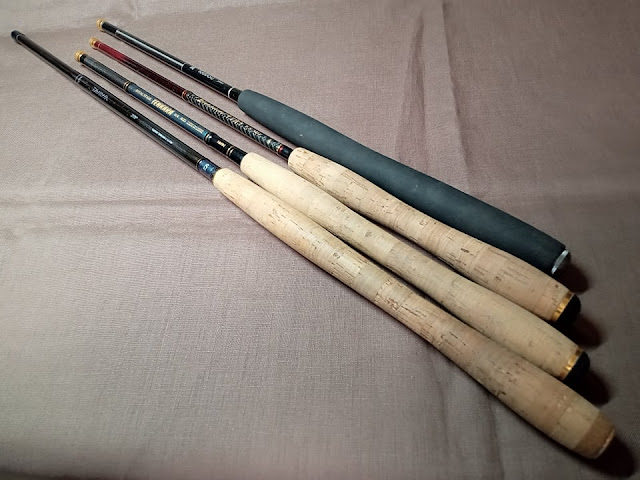
Adam Trahan: I use a Gamakatsu Suimu. Such a great rod. There are very few people outside of Japan that use them. I own all three sizes and each size is good for what it was designed for. The EX 400 is my mountain stream rod. It is my number one choice for tenkara. For Honryu, I choose the EX 450 and 500. I use these rods for their length and ability to fight big fish.
"Please tell me about your tenkara rod of choice. If you have anything to say about it, which one would you choose? Why?"
Shouetsu Goto: For tenkara I have about 10 rods, but I mainly use the Suimu EX400 and Keiho 3.3 (old type). Suimu has the advantages of being durable and hard to break, allowing for accurate casting because the shaking of the rod is quickly stopped, being powerful enough for long casting, and being able to quickly bring the fish to hand even if a large fish is hooked. I also use the Keiho. It is a rod with similar characteristics, and I have it for fishing narrow streams in Japan.

Adam Trahan: I met Yoshikazu Fujioka about 25 years ago. I started making a site for mountain stream fly fishing. I like the way Japanese people fish in mountain streams. Thank you to you and your wife for creating a YouTube channel "Genryu Izakaya" for those of us who love what you do.
Looking at your channel, I can see that the equipment you are using is working very well. I use some of it in my adventures. I just want to say thank you.
I enjoy sharing my interest in tenkara, which is why I make Tenkara Fisher available. I think that is the same reason for creating Genryu Izakaya.
"You have a website. I like your videos, magazine content, and books. What are you going to do with your it?"
Shouetsu Goto: I'm thinking about linking new YouTube videos, blogging about fishing trips, introducing the tools I use, and selling original goods.
The website is still incomplete.
Adam Trahan: It is late summer here, but our fishing season in Arizona is year-round. Many of our mountain streams get blanketed with snow and become unavailable due to road closures. This is the time of year we are looking to make our last great adventures of summer and then we get into fall which can be really good fishing but the snows of winter, it usually slows our fishing down.
Adam Trahan: It is late summer here, but our fishing season in Arizona is year-round. Many of our mountain streams get blanketed with snow and become unavailable due to road closures. This is the time of year we are looking to make our last great adventures of summer and then we get into fall which can be really good fishing but the snows of winter, it usually slows our fishing down.
I turn my attention to fishing in other directions. The rivers are farther down in warmer climates and the fishing there is good all winter. I used to do a lot of snowboarding and hiking in the lower mountains, but fishing mountain streams isn't really a wintertime activity for me. I tie kebari and think about and plan adventures for the new season. Here in town, they stock trout in our local ponds, so we go fishing and then cross the street and go to the bar!
Shouetsu Goto: I pick mushrooms and grapes in the mountains in autumn.
In winter, my wife and I go hunting. I often shoot ducks and wild birds. The feathers are available for tenkara kebari.

Adam Trahan: If you are ever in the area, please feel welcome at my home. We live in the desert Southwest, very different from your climate, however I have had Japanese friends who really like our desert vista. I would be happy to show you around.
I plan to visit your area with a friend that I introduced to tenkara. He has lived in Japan for thirty years so far. He is from Phoenix but married a Japanese gal and has a home in Tokyo. He now goes back and forth, and I will accompany him on a trip in the near future. He knows we have to visit your Izakaya when we go fishing in the Alps.
Sometimes I like to go to Hawaii and fish for trout on the island of Kauai. It reminds me a lot like Japan except there are no streams down past headwaters that hold trout. Kauai is too far South on the globe, only the streams that were stocked long ago near the top of the mountains in one specific area will sustain trout.
Besides travel, I don't do many other types of fishing. I used to do a lot of saltwater fly fishing and bass fishing when I was a young man. I might fish now and then in the sea or go bass fishing with my family, but it isn't my passion.
Recently, I have decided to start tanago (micro) fishing. There are places near my home where I can do that. I don't think it is anything like tenkara but it is something I have always wanted to do.

"Do you guys do any other kinds of fishing?"
Shouetsu Goto: Fishing for horse mackerel, kis and gobies in the ocean. In winter, I go smelt fishing.
Adam Trahan: Yuzo Sebata came to America in 1990 and toured the big Western Rivers with a camera crew from Toshiba. They documented his visit fishing the rivers with tenkara while interfacing with fly fishermen from the area. His tenkara is excellent as you know and even back then, he made it look like it was natural to be doing in the rivers.
Twenty years later, the company Tenkara USA was able to sell tenkara rods to the public. The company produced a lot of videos and marketed tenkara. I believe it was the combination of the Internet and the simplicity of this style of fishing that appealed to new fishing customers.
I don't think it was better than Sebata san's introduction, I believe it was different. The timing and the ease of use for people to use their computer's and pull up the content is what helped tenkara get started outside of Japan. Timing is everything, that's what they say and it's really true.
There is more about that but what is important, tenkara is now outside of Japan and it is growing.
"What do you think about that? What do you think about tenkara being practiced outside of Japan?"
Shouetsu Goto: I'm happy that tenkara is becoming popular outside of Japan. And I would like you to change freely without being bound by Japanese traditions and styles. I also want to try tenkara fishing abroad.

Adam Trahan: I like Ayu fishing! But we do not have Ayu here. I like Tanago fishing but we do not have Tanago here. We have species of fish that some of the equipment that was developed specifically for that can be used for our fishing here. But the keiryu equipment (mountain stream fishing) developed in Japan has had the luxury of much more experience and time and lots of resources to develop the best equipment.
Japanese engineering is a testament to improvement.
I like the philosophy that goes along with improvement, Kaizen being one example that can be used to help improve anything including one's own life.
"You have read here how much I like what you do, what the Japanese culture does that I like, is there anything that American tenkara people do that you like? Or is there something that we should be doing?"
Shouetsu Goto: I know Adam loves Japanese culture and tenkara.
Adam Trahan: I was taught to fish by my Grandfather. He did not even like to fish, my Grandmother loved to fish. My Grandfather likes to live by the lake and drive a boat. It was a good arraignment. Before my Grandfather passed away, he helped me develop a "fly" for the catfish in our pond. I was really proud that he was able to see my fly fishing.
"Please tell us who taught you to fish, also, who is influential to your fishing?"
Shouetsu Goto: My father taught me when I was little. At that time, when I was fishing. My father was working in the mountains, so we went fishing in the headwaters.
I started tenkara only 15 years ago, because I admired Yuzo Sebata's style of fishing when I saw the magazine "Keiryu."
After that, I had the chance to go fishing with Mr. Masami Sakakibara and Shinichi Takakuwa.
I saw Mr. Sakakibara fishing and learned the effectiveness of tenkara fishing. I accompanied Mr. Takakuwa and learned how to have fun in the valley.
Adam Trahan: Before I started tenkara, I was making bamboo fly rods. I was making a kind of secret website. We have gathered many great bamboo rod makers from around the world to talk about bamboo fly rod fishing and the secrets of making great rods. For me, I think the best tenkara fishers outside of Japan come from a background in fly fishing.
Occasionally, I pick up one of my self-made rods or a sweet graphite fly rod and toss it out in the garden. We haven't forgotten how to shoot the entire line.

"What do you think of fly fishing compared to Tenkara?"
Shouetsu Goto: I used to fly fish too. I think fishing is a lot of fun. I think it's wonderful that you can learn about aquatic insects and enjoy not only rivers but also lakes and seas.
Some people say that tenkara has an advantage over fly fishing in the Japanese climate, but that doesn't matter. You just have to do what makes you feel like having "fun."
My style of fishing is mountain climbing and sawanobori, so tenkara suits my style because it allows me to prepare and clean up quickly. The tools are also very light and good.
In Japan, there are many headwater anglers who enjoy fly fishing only with dry flies.
Adam Trahan: My first fishing trip to Japan was hosted by Satoshi Miwa, a Japanese biologist. I met Miwa san through my fly-fishing site, smallstreams.com It was shortly after I quit fly fishing to be very good at tenkara. It was a wonderful visit but sort of odd in that my Japanese friend fly fished with me and I did tenkara. He ended up writing a story about how we toured the alps, the Nagano area. He is from Mie prefecture, and it was quite a drive for him. I did visit his area and we went to Iga, the Ninja village as I have a fascination for Ninjutsu. Miwa san ended up doing some translation and hosting of other tenkara fishers. On our trip we also shared a day with Masami Sakakibara on the Itoshiro river. He really tuned the western fly fisher cast out of me and helped me develop my own technique.
On our trip, many new friends were made. I introduced Japanese friends to other Japanese friends not so much on purpose but because I was traveling and being hosted by friends in different areas.
Tenkara seems very special in Japan and I have noticed, it is not as popular as fly fishing.
"Can you tell me about the growth of tenkara in the last ten years and is it becoming more popular?"
Shouetsu Goto: I'm not in the position of a fishing tackle manufacturer or a mass media company such as a magazine, so I can't judge whether tenkara in Japan is becoming more popular or growing.
From the standpoint of a tenkara fan, I feel that the types of rods and tools are decreasing, and the number of shops where you can get them is also decreasing. The fishing magazine itself is getting more and more out of print.
Nowadays, we are in the age of getting goods and information on the Internet, but I don't feel that tenkara's information is increasing.
I'm happy to hear from time to time that they started playing tenkara after watching Genryu Izakaya on YouTube.

Adam Trahan: My visits to Japan are not fishing trips. They are cultural experiences with some fishing.
I understand from my friends in Japan that the old ways are being forgotten. Young people are moving to the cities and with that, the passage of the traditional crafts is being lost.
The bansho that I stayed at in Tadami was old and beautiful. The gasso style home I stayed at in Gokayama was old and very beautiful as well. The techniques that these houses are made with are quite special. The grass roofs need to be replaced and it cannot be done by one person.
In your videos, I see that you and your wife have purchased a home in the country.
"Can you tell us about your home? What are your plans with the Izakaya and anything else you can tell us?"
Shouetsu Goto: The house I bought after moving from Tokyo is located in Toga Village in Nanto City, Toyama Prefecture. Toga Village is part of the Five Mountains, and in the past, there were many Gassho-zukuri. My house is also an old private house that is more than 150 years old, and it used to be made of gassho.
With the help of fishing buddies and YouTube fans, we renovated over the course of a year, started living in April 2022, and were able to open as a tavern in June. All we asked the contractor to do was water and gas, and everything from the foundation under the floor to the floor, walls, and ceiling made it a house with a strong sense of affection that we created with our friends.
Many locals and people who come to fish come to drink.
You can eat dishes that we make on YouTube.
Adam Trahan: I am 61 years old. I enjoy shooting my guns at a target facility. I have some hunting friends that are teaching me about hunting but there is a lottery and I have not won my ticket yet. I can hunt with a bow but I have to learn the bow technique first.
I already do too many things so I will just stick to my guns.
I see that Yoko san hunts.
"Can you tell us about hunting in Japan?"
Shouetsu Goto: Yoko and I hunt. The animals that live here are different depending on the region, and like tenkara, there are various hunting styles. Some people hunt in groups using dogs.
Some people use traps.
We like walking in the mountains, so we like to follow the tracks of beasts, approach them, and confront our prey. I think it's similar to tenkara.
Adam Trahan: The first time I came to Japan was when I was in the Army. We drove the caravan from Yokohama to Camp Fuji Marine Base. I practiced live fire with the Japanese army there. I am very proud to have trained with your military personnel. I am very honored. After living at the foot of Mt. Fuji for about a month, I learned about the weather and atmosphere of Mt. Fuji. I understand that it is a very special place for Japanese people.
"Is there a special tenkara place in Japan? I hear a lot about Kurobe. Can you tell me a special tenkara place?
Shouetsu Goto: I go fishing by myself, so I don't often go to famous places.
Kurobe and Okutone are famous in magazines, and we used to go there a lot, but we lost interest because of the crowds.
Now I'm wandering around looking for the source where no one comes.

Adam Trahan: Shouetsu-san, thank you for helping spread the word of tenkara through my interview readers. Thank you. I first learned about the historical tenkara from Soseki Yamamoto's book. His writings included many tenkara fishermen. Like Mr. Yamamoto, I try to involve as many people as possible in my tenkara coverage.
Shouetsu Goto: I have friends outside of Japan who are interested in tenkara and who understand it. I am very happy to be here. I think they are learning more about Japanese and tenkara culture than us Japanese.
Please continue to do your best to disseminate information overseas.
Thank you very much for this time.